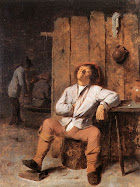
A Nazirite Receives a Haircut
Judges 21: 15-21 (The New Situationally Edited Revised Standard Version)
And she said to him, "How can you say, 'I love you,' when your heart is not with me? You have mocked me these three times, and you have not received a haircut when I asked." 16 And when she pressed him hard with her words day after day, and urged him, his soul was vexed to death. 17 And he told her all his mind, and said to her, "Fine, I'll get a haircut."
. . . . . . . 19 She made him go to a certain barbershop; and she called a man, and had him shave off the seven locks of his head. Then she began to torment him, and his strength left him. 20 And she said, "Wow, you look dandy, John!" And he awoke from the barber's chair and said, "I do look good, though."
Sunday, January 25, 2004
Thursday, January 22, 2004
A Brief History Continued
I neglected to mention yesterday that the transferrence of power from Germany to Belgium occurred after Germany fared badly in World War I. Belgium governed the territory as one territory Ruanda-Urundi.
Burundi gained independence on July 1st, 1962. With weak democratic institutions, the Tutsi King Mwabutsa IV formed a constitutional monarchy which was made up of equal numbers of Hutus and Tutsis. In 1965, the Hutu prime minister was assassinated and this triggered a number of destabilizing revolts by the Hutu. In 1966, Prince Ntare IV overthrew his own father and himself was deposed that very same year by a military coup. Capt. Michel Micombero abolished the monarchy and declared a Burundi a republic. A republic did not emerge, however, and Burundi was a military regime. In 1972, there was a large-scale Hutu rebellion and hundreds of thousands of Burundians were put to flight. Instability reigned throughout the seventies. Col. Jean-Baptiste Bagaza seized power in 1976, leading a Tutsi-dominated military regime. Bagaza, a reformer, introduced changes in property and election laws and promoted reconciliation between Hutus and Tutsis.
Bagaza's promising start deteriated when he ws elected head of state as the sole candidate in 1984. Religious activities were suppressed and political opposition was imprisoned. Finally, in 1987, Bagaza was overthrow by Major Pierre Buyoya who then instituted his ruling Military Committee for National Salvation. Tensions rose between Tutsis and Hutus as the Hutu majority clashed with the ruling Tutsi hardliners. An estimated 150,000 people were killed and tens of thousands of refugees fled in the unrest of 1988. Buyoya issued a commission to investigate the causes of the 1988 bloodbath and attempt to create a charter for democratic reform.
In 1991, a new constitution was approved by Buyoya which detailed the need for a president, a multiethnic government, and a parliament. In 1993, Burundi's first Hutu president, Melchior Ndadaye was elected. In October of that year, Ndadaye was assassinated by a faction from the Tutsi-dominated army. Civil war ensued and tens of thousands of people were killed and displaced in the chaos.
The government of Ndadaye regained control and Cyprien Ntaryamira was elected president in January 1994. Finally in April 1994 the airplane of President Ntayarmira and Rwandan president Habyarimana was shot down, killing both men. This infamous act marked the beginning of the Rwandan genocide. While the world glanced in mild interest at the horror in Rwanda, Burundi was plunged into more violence and unrest.
Rwanda also gained independence on July 1st 1962. From 1962 until 1973 Rwanda was ruled by Gregoire Kaybanda. In 1973, a bloodless coup occurred in which the Hutu General, Juvenal Habyarimana, seized power. So while Burundi was ruled by a Tutsi elite after independence, Rwanda was ruled by a Hutu elite under Habyarimana. Habyarimana favoured his own clan and those in prime positions were most often his relations or from his home territory. Apparently, members of this favoured group, theAkazu, or little house, played a large role in the 1994 genocide by commanding the murderous Presidential guard and controlling the hate radio station. Habyarimana and his Akazu efficiently governed Rwanda with tight control. Political and press freedom were severely curtailed but religous freedom was allowed. Tutsis were severely discrimated against and banned from political activity and forced to carry identity cards, a holdover from Belgian colonialism.
The Rwandan Patriotic Front, the Tutsi-dominated rebel force led by Paul Kagame, invaded in 1990. The RPF was mainly comprised of Tutsi refugees who wished to return to their Rwandese homeland. The RPF had been founded in 1979 by Tutsi refugees and had fought as mercenaries in Uganda. Paul Kagame, an extremely intelligent leader and a military genius, made sure he had a number of Hutus among his supporters. He hoped the Hutu would welcome him as deliverer, but this hope was dashed when Hutu elements skillfully manipulated the radio propaganda to spread fear among the people. It wasn't until April of 1994 when moderate Hutus were being targeted by the genocidaires that the RPF found support among the Hutu. This invasion by the RPF led to large-scale mobilization of the Rwandan Governmental Forces (RGF) and in a decision that was to have horrendous results, arms were distributed among civilian officials.
Discontent reigned among the Hutu as the economy was weak and the government oppressive. Habyarimana's party divided itself into hardliners who did not wish to give the Tutsis any conciliation and moderates who were willing to talk. These two elements struggled against eachother and it appeared peace talks would go nowhere. Habyarmina's plane was shot down in 1994, killing him and the Burundian president. Then all hell broke loose.
It is a vast oversimplification to blame the Tutsis or the Hutus for the genocides and killings which began after independence. It is true that the primary blame for the genocide in Rwanda rests with the Hutu elites and the genocide in Burundi lies with the Tutsi elites it is important to realize that both communities have substantial amounts of moderates and in the targeted communities in both countries there are a number of radicals. It is also important to note that in the infamous 1994 genocide in Rwanda, the Hutu extremists and the RGF carried out the worst of the genocides, but the Rwandan Patriotic Front (RPF) a force of Tutsi expatriates was also guilty of war crimes. In both Burundi and Rwanda, leaders have exploited the Hutu-Tutsi tension to justify their monopoly of power. They argue that all people needed to do was to look across the border to see what would happen if the Tutsi or the Hutu gained power.
I neglected to mention yesterday that the transferrence of power from Germany to Belgium occurred after Germany fared badly in World War I. Belgium governed the territory as one territory Ruanda-Urundi.
Burundi gained independence on July 1st, 1962. With weak democratic institutions, the Tutsi King Mwabutsa IV formed a constitutional monarchy which was made up of equal numbers of Hutus and Tutsis. In 1965, the Hutu prime minister was assassinated and this triggered a number of destabilizing revolts by the Hutu. In 1966, Prince Ntare IV overthrew his own father and himself was deposed that very same year by a military coup. Capt. Michel Micombero abolished the monarchy and declared a Burundi a republic. A republic did not emerge, however, and Burundi was a military regime. In 1972, there was a large-scale Hutu rebellion and hundreds of thousands of Burundians were put to flight. Instability reigned throughout the seventies. Col. Jean-Baptiste Bagaza seized power in 1976, leading a Tutsi-dominated military regime. Bagaza, a reformer, introduced changes in property and election laws and promoted reconciliation between Hutus and Tutsis.
Bagaza's promising start deteriated when he ws elected head of state as the sole candidate in 1984. Religious activities were suppressed and political opposition was imprisoned. Finally, in 1987, Bagaza was overthrow by Major Pierre Buyoya who then instituted his ruling Military Committee for National Salvation. Tensions rose between Tutsis and Hutus as the Hutu majority clashed with the ruling Tutsi hardliners. An estimated 150,000 people were killed and tens of thousands of refugees fled in the unrest of 1988. Buyoya issued a commission to investigate the causes of the 1988 bloodbath and attempt to create a charter for democratic reform.
In 1991, a new constitution was approved by Buyoya which detailed the need for a president, a multiethnic government, and a parliament. In 1993, Burundi's first Hutu president, Melchior Ndadaye was elected. In October of that year, Ndadaye was assassinated by a faction from the Tutsi-dominated army. Civil war ensued and tens of thousands of people were killed and displaced in the chaos.
The government of Ndadaye regained control and Cyprien Ntaryamira was elected president in January 1994. Finally in April 1994 the airplane of President Ntayarmira and Rwandan president Habyarimana was shot down, killing both men. This infamous act marked the beginning of the Rwandan genocide. While the world glanced in mild interest at the horror in Rwanda, Burundi was plunged into more violence and unrest.
Rwanda also gained independence on July 1st 1962. From 1962 until 1973 Rwanda was ruled by Gregoire Kaybanda. In 1973, a bloodless coup occurred in which the Hutu General, Juvenal Habyarimana, seized power. So while Burundi was ruled by a Tutsi elite after independence, Rwanda was ruled by a Hutu elite under Habyarimana. Habyarimana favoured his own clan and those in prime positions were most often his relations or from his home territory. Apparently, members of this favoured group, theAkazu, or little house, played a large role in the 1994 genocide by commanding the murderous Presidential guard and controlling the hate radio station. Habyarimana and his Akazu efficiently governed Rwanda with tight control. Political and press freedom were severely curtailed but religous freedom was allowed. Tutsis were severely discrimated against and banned from political activity and forced to carry identity cards, a holdover from Belgian colonialism.
The Rwandan Patriotic Front, the Tutsi-dominated rebel force led by Paul Kagame, invaded in 1990. The RPF was mainly comprised of Tutsi refugees who wished to return to their Rwandese homeland. The RPF had been founded in 1979 by Tutsi refugees and had fought as mercenaries in Uganda. Paul Kagame, an extremely intelligent leader and a military genius, made sure he had a number of Hutus among his supporters. He hoped the Hutu would welcome him as deliverer, but this hope was dashed when Hutu elements skillfully manipulated the radio propaganda to spread fear among the people. It wasn't until April of 1994 when moderate Hutus were being targeted by the genocidaires that the RPF found support among the Hutu. This invasion by the RPF led to large-scale mobilization of the Rwandan Governmental Forces (RGF) and in a decision that was to have horrendous results, arms were distributed among civilian officials.
Discontent reigned among the Hutu as the economy was weak and the government oppressive. Habyarimana's party divided itself into hardliners who did not wish to give the Tutsis any conciliation and moderates who were willing to talk. These two elements struggled against eachother and it appeared peace talks would go nowhere. Habyarmina's plane was shot down in 1994, killing him and the Burundian president. Then all hell broke loose.
It is a vast oversimplification to blame the Tutsis or the Hutus for the genocides and killings which began after independence. It is true that the primary blame for the genocide in Rwanda rests with the Hutu elites and the genocide in Burundi lies with the Tutsi elites it is important to realize that both communities have substantial amounts of moderates and in the targeted communities in both countries there are a number of radicals. It is also important to note that in the infamous 1994 genocide in Rwanda, the Hutu extremists and the RGF carried out the worst of the genocides, but the Rwandan Patriotic Front (RPF) a force of Tutsi expatriates was also guilty of war crimes. In both Burundi and Rwanda, leaders have exploited the Hutu-Tutsi tension to justify their monopoly of power. They argue that all people needed to do was to look across the border to see what would happen if the Tutsi or the Hutu gained power.
Wednesday, January 21, 2004
A Brief History of Rwanda and Burundi
Before I begin my promised reporting on Lieutenant General Romeo Dallaire’s book Shake Hands with the Devil I would like to contextualize the genocides by writing a little bit about Rwanda and Burundi’s histories. This will be part one, tomorrow I’ll have part two, and sometime later I’ll write about Dallaire’s book. Many people assume that twentieth-century Hutus and Tutsis are merely carrying on the tribal warfare they have engaged in since time immemorial. In fact, the designations of Hutu and Tutsi had much less significance in the past than they do today. The categories did exist, but they were based on class distinctions more than ethnicity. The Hutu were cultivators while the Tutsi were cattle-herders. A rich Hutu could purchase a number of cows and become a Tutsi and a Tutsi who fell on hard times would become a Hutu farmer. There was some degree of movement up and down the political hierarchy. While it is fair to say that the Tutsis were the dominant aristocrats/warriors it is misleading to claim they were oppressive feudal lords. Evidence points to a more mutually acceptable nature of society as there is no sign of large-scale ethnic killings. In fact, the wars that did occur were against rival kingdoms, some of which were Hutu-controlled. These were not ethnic wars but pitted tribally-mixed militias and armies against each other, and it was not unusual for these militias and armies to be led by Hutu generals. In addition to being important economic and social forces, these armies and militias were strong cultural forces, engaging in poetry, dance, and song. Interestingly enough, the Tutsi and Hutu still share these cultural traits (as well as their language.)
When the colonizers began entering Rwanda and Burundi at the beginning of the twentieth century, the designations of Hutu and Tutsi took on a drastic change. First the Germans and then the Belgians entered the mountainous region of East-Central Africa. Both European nations had firm convictions about racial hierarchy and the superiority of the white race. Now, it was too simple for the Belgians to relegate all Africans to inferior status, they had to create an African hierarchy. The Tutsis, who tend to be taller and slimmer, thoroughly impressed the Belgians as descendants of a long-lost Caucasian tribe. This had much to do with the reluctance of Europeans at this time to credit black Africa with having any sort of civilization: clearly, the highly centralized states of Rwanda and Burundi were an aberration and could only be explained away by pointing to the role of some sort of Caucasian migration from Ethiopia’s rich civilization (This resulted in such ridiculous names as AfricanAryans and Black Caucasians.) It is important to note that Tutsis and Hutus had mixed quite a bit of their blood by this time and although certain differences were apparent, there were many Tutsis and Hutus who did not meet their stereotyped physical attributes. (In fact, Europeans who visited a village in Rwanda recently only guessed two out of seven Rwandan tribal identities correctly.) The Belgians looked at the supposed European-like features of Tutsis and considered them born rulers.
The Belgians did not like the idea of Tutsis and Hutus constantly switching tribes and, in 1926, they made certain that no more tribal movement would occur by issuing identity cards which included an entry for tribe. With this, all the benefits and hopes of the Hutus were lost as they could no longer advance socially and all the little power and authority they had previously was stripped away from them. Later, after World War II, the tactics of the Belgians changed. Belgian Marxists who thought in terms of class struggle encouraged the Hutu “proletariats” to resist the Tutsi “bourgeoisie.” Towards the end of colonization the hierarchy was reversed and the Hutu became favoured while the Tutsi fell into disfavour. Roman Catholic priests armed with the new Catholic social justice teachings of the Young Christian workers readily favoured the Hutu over the Tutsi. Some scholars convincingly argue that the switch in support by the Belgians had as much to do with their changing perspectives as it did with their desire to destabilize those they wished to control.
Before I begin my promised reporting on Lieutenant General Romeo Dallaire’s book Shake Hands with the Devil I would like to contextualize the genocides by writing a little bit about Rwanda and Burundi’s histories. This will be part one, tomorrow I’ll have part two, and sometime later I’ll write about Dallaire’s book. Many people assume that twentieth-century Hutus and Tutsis are merely carrying on the tribal warfare they have engaged in since time immemorial. In fact, the designations of Hutu and Tutsi had much less significance in the past than they do today. The categories did exist, but they were based on class distinctions more than ethnicity. The Hutu were cultivators while the Tutsi were cattle-herders. A rich Hutu could purchase a number of cows and become a Tutsi and a Tutsi who fell on hard times would become a Hutu farmer. There was some degree of movement up and down the political hierarchy. While it is fair to say that the Tutsis were the dominant aristocrats/warriors it is misleading to claim they were oppressive feudal lords. Evidence points to a more mutually acceptable nature of society as there is no sign of large-scale ethnic killings. In fact, the wars that did occur were against rival kingdoms, some of which were Hutu-controlled. These were not ethnic wars but pitted tribally-mixed militias and armies against each other, and it was not unusual for these militias and armies to be led by Hutu generals. In addition to being important economic and social forces, these armies and militias were strong cultural forces, engaging in poetry, dance, and song. Interestingly enough, the Tutsi and Hutu still share these cultural traits (as well as their language.)
When the colonizers began entering Rwanda and Burundi at the beginning of the twentieth century, the designations of Hutu and Tutsi took on a drastic change. First the Germans and then the Belgians entered the mountainous region of East-Central Africa. Both European nations had firm convictions about racial hierarchy and the superiority of the white race. Now, it was too simple for the Belgians to relegate all Africans to inferior status, they had to create an African hierarchy. The Tutsis, who tend to be taller and slimmer, thoroughly impressed the Belgians as descendants of a long-lost Caucasian tribe. This had much to do with the reluctance of Europeans at this time to credit black Africa with having any sort of civilization: clearly, the highly centralized states of Rwanda and Burundi were an aberration and could only be explained away by pointing to the role of some sort of Caucasian migration from Ethiopia’s rich civilization (This resulted in such ridiculous names as AfricanAryans and Black Caucasians.) It is important to note that Tutsis and Hutus had mixed quite a bit of their blood by this time and although certain differences were apparent, there were many Tutsis and Hutus who did not meet their stereotyped physical attributes. (In fact, Europeans who visited a village in Rwanda recently only guessed two out of seven Rwandan tribal identities correctly.) The Belgians looked at the supposed European-like features of Tutsis and considered them born rulers.
The Belgians did not like the idea of Tutsis and Hutus constantly switching tribes and, in 1926, they made certain that no more tribal movement would occur by issuing identity cards which included an entry for tribe. With this, all the benefits and hopes of the Hutus were lost as they could no longer advance socially and all the little power and authority they had previously was stripped away from them. Later, after World War II, the tactics of the Belgians changed. Belgian Marxists who thought in terms of class struggle encouraged the Hutu “proletariats” to resist the Tutsi “bourgeoisie.” Towards the end of colonization the hierarchy was reversed and the Hutu became favoured while the Tutsi fell into disfavour. Roman Catholic priests armed with the new Catholic social justice teachings of the Young Christian workers readily favoured the Hutu over the Tutsi. Some scholars convincingly argue that the switch in support by the Belgians had as much to do with their changing perspectives as it did with their desire to destabilize those they wished to control.
Tuesday, January 20, 2004
Sentence Fragments
A columnist in the Hamilton Spectator. She uses sentence fragments. All the time. It gets on my nerves. Is it effective? No. I already hate reading articles about dogs who got hit by cars. Now its cars hitting dogs. Bicycles stolen. Pellet gun shootings. All in sentence fragments. On the front page. Consistently. Yuck. Then again. The Spectator. Not exactly a great paper.
A columnist in the Hamilton Spectator. She uses sentence fragments. All the time. It gets on my nerves. Is it effective? No. I already hate reading articles about dogs who got hit by cars. Now its cars hitting dogs. Bicycles stolen. Pellet gun shootings. All in sentence fragments. On the front page. Consistently. Yuck. Then again. The Spectator. Not exactly a great paper.
Maybe He Should Read Political Visions and Illusions?
"The great political ideologies of the twentieth century include liberalism, socialism, anarchism, corporatism, Marxism, communism, social democracy, conservatism, nationalism, fascism, and Christian Democracy. They all share one thing in common: they are products of Western civilization. No other civilization has generated a significant political ideology. The West, however has never generated a great religion. The great religions of the world are all products of non-Western civilizations and, in most cases, antedate Western civilization." - Samuel P. Huntington, The Clash of Civilizations and the Remaking of the World Order
"The great political ideologies of the twentieth century include liberalism, socialism, anarchism, corporatism, Marxism, communism, social democracy, conservatism, nationalism, fascism, and Christian Democracy. They all share one thing in common: they are products of Western civilization. No other civilization has generated a significant political ideology. The West, however has never generated a great religion. The great religions of the world are all products of non-Western civilizations and, in most cases, antedate Western civilization." - Samuel P. Huntington, The Clash of Civilizations and the Remaking of the World Order
Thursday, January 15, 2004
Oh damned book, History of the Low Countries!
You're out of print, you historical sleaze!
I searched high and low for you, you devil
in every corner and on every level
You, oh antiquated book, fail to see
that I need you for a fourth level history!
E.H. Kossman is your author and a knave
to print too few copies of what I crave
blame the publisher if you will
its E.H. Kossman I want to kill
I know I'm being harsh and unfair
but your utter scarcity I cannot bear
I'm sure Kossman is a nice fellow
and I know I should be more mellow
but when I order a copy of you, you cur
I don't want E.H. Kossman's `93 brochure!
So, you hard-covered pretentious freak
I expect you at my house at the end of the week!
Regards.
P.S. I bet you're not even a good read.
You're out of print, you historical sleaze!
I searched high and low for you, you devil
in every corner and on every level
You, oh antiquated book, fail to see
that I need you for a fourth level history!
E.H. Kossman is your author and a knave
to print too few copies of what I crave
blame the publisher if you will
its E.H. Kossman I want to kill
I know I'm being harsh and unfair
but your utter scarcity I cannot bear
I'm sure Kossman is a nice fellow
and I know I should be more mellow
but when I order a copy of you, you cur
I don't want E.H. Kossman's `93 brochure!
So, you hard-covered pretentious freak
I expect you at my house at the end of the week!
Regards.
P.S. I bet you're not even a good read.
I just updated my blog-links. This isn't a full update but at least I made the effort. I left people out, not because I hate them but because I'm a classic under-achiever and quite pusillanimous about failure. These are all people I know or that I think I know or maybe just people that someone I know knows. Whatever the case, I'm linking them. The list isn't alphabetized as of yet but I will do that when I get around to getting a haircut or maybe later, I dunno.
Monday, January 12, 2004
Racism
As some people might know, I am in what has been termed an "interracial relationship." I like to think of the world consisting of one human race divided into a plethora of unique shapes and colours rather than to think of a world consisting of a complex division of races. Unfortunately for my idealism there are many people in this world who enjoy dividing people into separate races and not only categorizing them, but also creating general laws about their behaviour. Because of these people, race does exist.
One of the questions I am often asked when someone finds out that I am dating an African woman is whether I encounter a lot of racism. No one has burned a cross on my lawn, yet, and sometimes I think that is the sort of incident people are fishing for. The racism I have encountered is a lot more subtle, but it still can sting. A member of the K-9 unit ordered us out of a Wendy's because we were "scaring off customers." People have gone right out and stated that I am wrong to be involved with an African woman. One such incident which sticks indelibly in my mind is the seven-year-old who stated matter-of-factly that, "white is for white and black is for black." In order for a child of this age to learn such a thing, I believe they have to be taught by society or an older adult.
Usually, however, the racism is a lot less blatant than even that. Racist jokes are cut off half-way through, not because of my glowering face, but because a friend of mine is jutting his elbow intensely into the side of their unenlightened friend. People refer to my girlfriend and all of the people who share her skin colour as "them" and then proceed to make generalizations like, "I hear black girls are wild in bed." Now, I can't make an empirical judgement on that because, being a virgin, I've never had sex with a black girl or a white girl or an asian girl; and if I had, I'd have to sleep with all of them before I could make a scientific judgement. Still, I can say with reasonable certainty that such a ridiculous statement is merely the manisfestation of a racist's objectified fantasy of black women imposed upon reality. I'm entirely certain there are black woman who are terribly subdued in bed. All this to say that race, although it may shape an individual, does not determine personality or character.
This past summer, at her workplace, my girlfriend was having a lot of difficulty getting any amount of cooperation with one of the managers she had was working with. She finally told her supervisor of her difficulty, not as a complaint but as an explanation. The next day, this manager called her into her office.
After explaining himself he apologized profusely and then defended himself, "I'm not a racist. I've worked with all kinds of people and I've never had difficulty. I've worked with Vietnamese, Pakistani, Russian, and Chinese and even you people, and I've never had difficulty."
"You've worked with Burundian people before?" my girlfriend asked in surprise.
The manager gave her a bemused look of confused perplexion and then continued his defence. My girlfriend was oblivious by this time, completely irate at being relegated to the status of "you people."
I was taught in school that racism was no longer a problem. I remember in grade 4 some East Indian women were invited to share their culture with my class. They spoke about their culture and traditions and then the time for questions began. One of the students raised their hands and asked, "do you have trouble with racism?" One of the ladies answered that yes, she did, and then she explained how one of her neighbours would cross to the other side of the street rather than pass her on the same side of the street. After the women had left my teacher dismissed their story and explained to the class that racism wasn't a problem anymore.
Martin Luther King had made his speech, see? Everyone was equal, see? I won't argue that the rights of visible minorities haven't improved immensely but I will not settle into the comfortable ridiculousness of claiming racism is no longer a real problem. Many people seem to want to confine racism to incidents where the KKK shows up with torches or some local kids scrawl racist epithets on a wall. Racism in Canada often manifests in a sort of "polite racism." This involves polite shunning, polite generalizations, polite refusal, and polite ignorance. Okay, I'll be honest and admit that "polite racism" is an oxymoron and that Canadians are often worse than southern Americans. Why? If a southern American is racist he or she will come right out and tell you, a northern American or Canadian, on the other hand, will constantly hedge.
Canadians shouldn't comfort themselves with the opiate that most people aren't racist. One racist teacher, one racist boss, one racist policeman, can taint an entire institution. Stereotypes and generalizations create distrust and foster hatred. We need to build an atmosphere of love and communication between Canada's vast a varied cultural mosaic.
"Until the colour of a man's skin is of no more significance than the colour of his eyes, this a war." - Robert Nesta Marley, putting the words of Emperor Haile Selassie's 1936 speech to the League of Nations to song.
As some people might know, I am in what has been termed an "interracial relationship." I like to think of the world consisting of one human race divided into a plethora of unique shapes and colours rather than to think of a world consisting of a complex division of races. Unfortunately for my idealism there are many people in this world who enjoy dividing people into separate races and not only categorizing them, but also creating general laws about their behaviour. Because of these people, race does exist.
One of the questions I am often asked when someone finds out that I am dating an African woman is whether I encounter a lot of racism. No one has burned a cross on my lawn, yet, and sometimes I think that is the sort of incident people are fishing for. The racism I have encountered is a lot more subtle, but it still can sting. A member of the K-9 unit ordered us out of a Wendy's because we were "scaring off customers." People have gone right out and stated that I am wrong to be involved with an African woman. One such incident which sticks indelibly in my mind is the seven-year-old who stated matter-of-factly that, "white is for white and black is for black." In order for a child of this age to learn such a thing, I believe they have to be taught by society or an older adult.
Usually, however, the racism is a lot less blatant than even that. Racist jokes are cut off half-way through, not because of my glowering face, but because a friend of mine is jutting his elbow intensely into the side of their unenlightened friend. People refer to my girlfriend and all of the people who share her skin colour as "them" and then proceed to make generalizations like, "I hear black girls are wild in bed." Now, I can't make an empirical judgement on that because, being a virgin, I've never had sex with a black girl or a white girl or an asian girl; and if I had, I'd have to sleep with all of them before I could make a scientific judgement. Still, I can say with reasonable certainty that such a ridiculous statement is merely the manisfestation of a racist's objectified fantasy of black women imposed upon reality. I'm entirely certain there are black woman who are terribly subdued in bed. All this to say that race, although it may shape an individual, does not determine personality or character.
This past summer, at her workplace, my girlfriend was having a lot of difficulty getting any amount of cooperation with one of the managers she had was working with. She finally told her supervisor of her difficulty, not as a complaint but as an explanation. The next day, this manager called her into her office.
After explaining himself he apologized profusely and then defended himself, "I'm not a racist. I've worked with all kinds of people and I've never had difficulty. I've worked with Vietnamese, Pakistani, Russian, and Chinese and even you people, and I've never had difficulty."
"You've worked with Burundian people before?" my girlfriend asked in surprise.
The manager gave her a bemused look of confused perplexion and then continued his defence. My girlfriend was oblivious by this time, completely irate at being relegated to the status of "you people."
I was taught in school that racism was no longer a problem. I remember in grade 4 some East Indian women were invited to share their culture with my class. They spoke about their culture and traditions and then the time for questions began. One of the students raised their hands and asked, "do you have trouble with racism?" One of the ladies answered that yes, she did, and then she explained how one of her neighbours would cross to the other side of the street rather than pass her on the same side of the street. After the women had left my teacher dismissed their story and explained to the class that racism wasn't a problem anymore.
Martin Luther King had made his speech, see? Everyone was equal, see? I won't argue that the rights of visible minorities haven't improved immensely but I will not settle into the comfortable ridiculousness of claiming racism is no longer a real problem. Many people seem to want to confine racism to incidents where the KKK shows up with torches or some local kids scrawl racist epithets on a wall. Racism in Canada often manifests in a sort of "polite racism." This involves polite shunning, polite generalizations, polite refusal, and polite ignorance. Okay, I'll be honest and admit that "polite racism" is an oxymoron and that Canadians are often worse than southern Americans. Why? If a southern American is racist he or she will come right out and tell you, a northern American or Canadian, on the other hand, will constantly hedge.
Canadians shouldn't comfort themselves with the opiate that most people aren't racist. One racist teacher, one racist boss, one racist policeman, can taint an entire institution. Stereotypes and generalizations create distrust and foster hatred. We need to build an atmosphere of love and communication between Canada's vast a varied cultural mosaic.
"Until the colour of a man's skin is of no more significance than the colour of his eyes, this a war." - Robert Nesta Marley, putting the words of Emperor Haile Selassie's 1936 speech to the League of Nations to song.
Sunday, January 11, 2004
Rastafarians and Al Wolters
I'll sum up the beliefs of the Rastafarians very briefly and perhaps I'll make a more in-depth post at a later date.
Influenced by the oratory of the back-to-Africa leader Marcus Mosiah Garvey, the Rastafarians adopted Emporer Haile Selassie as God. Marcus Garvey himself never proclaimed this idea - in fact, he condemned it - but the Jamaican workers who heard his message to look to Africa for the coming of their Messiah were thoroughly impressed with the news of Ras Tafari Haile Selassie's coronation in 1930.
The divinity of Haile Selassie was not simply pulled out of Marcus Garvey's supposed prophecy. Selassie himself claimed to be descended from Solomon via the Queen of Sheba. Therefore, Selassie was of the line of David and Rastafarians could pull out all kinds of Biblical prophecies to support their claims to his divinity.
Of course, Rastafarianism has many more influences which have shaped it into the various sects it encompasses today. Hindu holy men who came to Jamaica as cheap labour brought their spiritual ideas, their ascetic lifestyle, and their appreciation of marijuana to the Rastafarian religion. Marxism, the Afro Athlican Constructive Church , Judaism, Christianity, obeah, and the repatriation movement also exerted influence.
The Bible is also a major influence. Some Rastafarians accept both the Old and the New Testaments while others only accept the Old Testament. Many Rastafarians acclaim what they call the "Holy Piby" which is a book adopted from the Afro Athlican Constructive Church. This gnostic book, which originated from the hand of Robert Athlyi Rogers from 1924-28, is a profoundly Afro-centric scripture.
Rastafarianism recognizes the Ethiopian people as the chosen people of God. Of course, in this sense, Ethiopia is not restrained to the modern boundaries of the state of Ethiopia but to the whole of Africa (The word Ethiopia is derived from the Greek Aithein (to burn) + ops (face). In Greek times, Ethiopian referred to anyone of a dark complexion and it is in this sense that Rastafarians use Ethiopian in.) As the chosen people of God, the Ethiopians disobeyed his will and were stolen from Zion (Africa) and brought to Babylon (the West.) After four hundred years of slavery, reminiscent of the slavery in Egypt, the time has come for the Ethiopians to free themselves from mental slavery and repatriate to Africa. Before, after, or during this repatriation, the Rastafarian can meditate and find their divinity and oneness with Jah (Selassie was/is the perfect expression of Jah on earth in the Rastafarian mind. Divinity and unity can be found in and with every man and woman, thus a Rasta will refer to himself/humanity as I & I to denote this universal experience.)
Now that I have given a cursory treatment of Rastafarian beliefs I can speak of one of the facets of Rastafarianism I find most interesting. Now, I'm not an expert and I may have this wrong, but it's worth a try. Rastafarians often refer to fire in their songs and in their daily life. Fire, for the Rastafarians, will cover the whole earth and burn away all wickedness. This obsession with fire might have a lot to do with the influence of Pentecostal fire and brimstone oratory but there is also an element of Al Wolter's Creation Regained. Now, I'm not saying that the Rastafarians have read Creation Regained, but they might find some things they'd agree with in there.
Sizzla Kalonji, a militant Bobo Ashanti singer drew much criticism when he sang a musical fire upon white attendees at a concert a few years ago. Sizzla defended his musical fire by stating that no one had to fear the fire as it was for purification. Many reggae singers have blazed a "musical fire" on everything from Babylon to themselves. The fire of Rastafari is not a fire of destruction but a fire of purification. Wicked Babylon can be purified in the flames and a conscious Rasta even needs the baptism of fire for purification. The creation is fine, it is the wickedness that needs to be burned out.
Just something I thought was interesting.
I'll sum up the beliefs of the Rastafarians very briefly and perhaps I'll make a more in-depth post at a later date.
Influenced by the oratory of the back-to-Africa leader Marcus Mosiah Garvey, the Rastafarians adopted Emporer Haile Selassie as God. Marcus Garvey himself never proclaimed this idea - in fact, he condemned it - but the Jamaican workers who heard his message to look to Africa for the coming of their Messiah were thoroughly impressed with the news of Ras Tafari Haile Selassie's coronation in 1930.
The divinity of Haile Selassie was not simply pulled out of Marcus Garvey's supposed prophecy. Selassie himself claimed to be descended from Solomon via the Queen of Sheba. Therefore, Selassie was of the line of David and Rastafarians could pull out all kinds of Biblical prophecies to support their claims to his divinity.
Of course, Rastafarianism has many more influences which have shaped it into the various sects it encompasses today. Hindu holy men who came to Jamaica as cheap labour brought their spiritual ideas, their ascetic lifestyle, and their appreciation of marijuana to the Rastafarian religion. Marxism, the Afro Athlican Constructive Church , Judaism, Christianity, obeah, and the repatriation movement also exerted influence.
The Bible is also a major influence. Some Rastafarians accept both the Old and the New Testaments while others only accept the Old Testament. Many Rastafarians acclaim what they call the "Holy Piby" which is a book adopted from the Afro Athlican Constructive Church. This gnostic book, which originated from the hand of Robert Athlyi Rogers from 1924-28, is a profoundly Afro-centric scripture.
Rastafarianism recognizes the Ethiopian people as the chosen people of God. Of course, in this sense, Ethiopia is not restrained to the modern boundaries of the state of Ethiopia but to the whole of Africa (The word Ethiopia is derived from the Greek Aithein (to burn) + ops (face). In Greek times, Ethiopian referred to anyone of a dark complexion and it is in this sense that Rastafarians use Ethiopian in.) As the chosen people of God, the Ethiopians disobeyed his will and were stolen from Zion (Africa) and brought to Babylon (the West.) After four hundred years of slavery, reminiscent of the slavery in Egypt, the time has come for the Ethiopians to free themselves from mental slavery and repatriate to Africa. Before, after, or during this repatriation, the Rastafarian can meditate and find their divinity and oneness with Jah (Selassie was/is the perfect expression of Jah on earth in the Rastafarian mind. Divinity and unity can be found in and with every man and woman, thus a Rasta will refer to himself/humanity as I & I to denote this universal experience.)
Now that I have given a cursory treatment of Rastafarian beliefs I can speak of one of the facets of Rastafarianism I find most interesting. Now, I'm not an expert and I may have this wrong, but it's worth a try. Rastafarians often refer to fire in their songs and in their daily life. Fire, for the Rastafarians, will cover the whole earth and burn away all wickedness. This obsession with fire might have a lot to do with the influence of Pentecostal fire and brimstone oratory but there is also an element of Al Wolter's Creation Regained. Now, I'm not saying that the Rastafarians have read Creation Regained, but they might find some things they'd agree with in there.
Sizzla Kalonji, a militant Bobo Ashanti singer drew much criticism when he sang a musical fire upon white attendees at a concert a few years ago. Sizzla defended his musical fire by stating that no one had to fear the fire as it was for purification. Many reggae singers have blazed a "musical fire" on everything from Babylon to themselves. The fire of Rastafari is not a fire of destruction but a fire of purification. Wicked Babylon can be purified in the flames and a conscious Rasta even needs the baptism of fire for purification. The creation is fine, it is the wickedness that needs to be burned out.
Just something I thought was interesting.
Friday, January 09, 2004
A New Year
To celebrate the transition from 2003 into 2004 this year my girlfriend convinced me to go to an acquaintance's party in Stoney Creek. The last two new years had been rather tranquil celebrations and Laurianne convinced me that I owed her some rowdiness.
On that fateful night of December the 31st I picked up some of our friends and headed to the party. After forty minutes of meandering around the suburban wilderness we finally found the Canaanites.
Tickets to the party were approximately ten dollars, and being the generous Dutchman that I am, I paid fifteen, allowing my girlfriend, in the interest of women's liberation, to pay the remaining five dollars. My hand was skillfully marked with a red Crayola marker, my keys were turned over, and I was given a plastic cup with my initials written crudely on it with black Crayola marker.
"Wait a minute," the slightly inebriated door-keeper intoned, "are you going to drink a lot?"
"No," I answered.
"Good," she said, "because you shouldn't drink and drive."
I nodded and followed my friends down the stairs to the basement, impressed with the party's security precautions. The basement was filled with sweaty drunken bodies. Individuals in red shirts cleverly titled Dube's New Keggers Eve Party served as security. With very little imagination I could see these shirts very soon gracing the rack of some local Value Village only to be thumbed through with very little thought by some bargain-hunter.
A lanky shaggy drunken fellow bumped into a zit-faced youth, "Hey, are you drunk?"
"Yeah," said the lanky fellow, "are you?"
"Yeah," the zit-faced youth bobbing in exaggerated inebriation, "I'm absolutely hammered!"
"Alright!" yelled the lanky fellow, and the two of them exchanged a clumsy high five.
I served myself a cup of beer from the keg, in the corner of a former bedroom. An absolutely humungous guy popped me the thumbs-up sign. I took a sip and then I noticed that the humungous guy was back for conversation, "that was kind of retarded wasn't it?"
"What?"
"When I gave you the thumbs-up sign," the humungous guy imitated himself giving a retarded thumbs-up sign, "that looked a little retarded, didn't it?"
"It didn't look to bad," I intoned, smiling.
"Good," the humungous guy smiled back and slapped my on the back with a huge paw. I nearly spilled my beer.
I went back out into the hall. The lanky fellow had his shirt off and was yelling, "at Marcel's party I was the only one who knew how to party!"
Fortunately, the lanky fellow had friends who restrained him and the shirt was soon in its rightful place on his back. A heavy-set curly-hair man in a trenchcoat was telling to girls that he was gay but he wasn't into, "all that gay shit."
I wandered over to the bar and noticed stacks of pizza boxes. I could do with a slice of pizza. There was a sign crudely marked, "50 cents a slice." I was not getting my money's worth.
I walked over to a larger room and noticed a drum kit and several individuals setting up their guitars and amplifiers. Excellent, I would be treated to a concert, maybe I would be getting my money's worth after all. Then the music started.
Now, I like a lot of music and I have paitence with most music, but this was a little too much. With a cacophony of poor rhythm, distorted guitars, and a badly played bass, the lead singer had his shirt off and along with some expletives was roaring such enlightening lyrics as, "I HATE YOU/ SHUT UP/ I HATE YOU," and so on and so forth. The music was not very welcoming.
The lanky fellow was entering the room on the back of a friend, a plastic cup in one hand, "AAAAAAAAAALRIIIIIGGHT!"
The lead singer had become unintelligable and approximately seven people were extremely pumped and forming a mini-moshpit at the front. The lead singer paused for an announcement, "Uh, the party down the street was shut down by the cops, so if all the underage people could stay down here for now that would help a lot."
Then the next song started off with a roaring, "WE DON'T NEED YOU!"
My friends decided to go for a smoke and I decided to accompany them. Outside several people were having a deep philosophical discussion about zippers, the smell of pot heavy in the air. The heavy-set curly haired man in trenchcoat was having a conversation with same two girls, no doubt about the same thing.
My Lebanese friend leaned over to my Quebecker friend, "There's the fag."
The heavy-set man looked up, "I am not a fag," he exclaimed effeminately.
My Lebanese friend was shaking his head in embarassment, my Quebecker friend was doubled over in laughter and then the lanky fellow stuck his head out of the sliding door, "Hey Maurice! I'm coming out."
"You do that," muttered an unenthusiastic Maurice.
The lanky fellow swayed forward and then backwards and then forward and then as he tried to step forward he swayed backwards and disappeared from sight, lying somewhere on the kitchen floor.
Two girls rushed out, frightened by a police cruiser they had spotted driving past the house. I found myself wishing that the police would come and send these underage drinkers into a drunken panic. That would be fun to watch.
We left twenty minutes later, without the cops having shown up at all.
To celebrate the transition from 2003 into 2004 this year my girlfriend convinced me to go to an acquaintance's party in Stoney Creek. The last two new years had been rather tranquil celebrations and Laurianne convinced me that I owed her some rowdiness.
On that fateful night of December the 31st I picked up some of our friends and headed to the party. After forty minutes of meandering around the suburban wilderness we finally found the Canaanites.
Tickets to the party were approximately ten dollars, and being the generous Dutchman that I am, I paid fifteen, allowing my girlfriend, in the interest of women's liberation, to pay the remaining five dollars. My hand was skillfully marked with a red Crayola marker, my keys were turned over, and I was given a plastic cup with my initials written crudely on it with black Crayola marker.
"Wait a minute," the slightly inebriated door-keeper intoned, "are you going to drink a lot?"
"No," I answered.
"Good," she said, "because you shouldn't drink and drive."
I nodded and followed my friends down the stairs to the basement, impressed with the party's security precautions. The basement was filled with sweaty drunken bodies. Individuals in red shirts cleverly titled Dube's New Keggers Eve Party served as security. With very little imagination I could see these shirts very soon gracing the rack of some local Value Village only to be thumbed through with very little thought by some bargain-hunter.
A lanky shaggy drunken fellow bumped into a zit-faced youth, "Hey, are you drunk?"
"Yeah," said the lanky fellow, "are you?"
"Yeah," the zit-faced youth bobbing in exaggerated inebriation, "I'm absolutely hammered!"
"Alright!" yelled the lanky fellow, and the two of them exchanged a clumsy high five.
I served myself a cup of beer from the keg, in the corner of a former bedroom. An absolutely humungous guy popped me the thumbs-up sign. I took a sip and then I noticed that the humungous guy was back for conversation, "that was kind of retarded wasn't it?"
"What?"
"When I gave you the thumbs-up sign," the humungous guy imitated himself giving a retarded thumbs-up sign, "that looked a little retarded, didn't it?"
"It didn't look to bad," I intoned, smiling.
"Good," the humungous guy smiled back and slapped my on the back with a huge paw. I nearly spilled my beer.
I went back out into the hall. The lanky fellow had his shirt off and was yelling, "at Marcel's party I was the only one who knew how to party!"
Fortunately, the lanky fellow had friends who restrained him and the shirt was soon in its rightful place on his back. A heavy-set curly-hair man in a trenchcoat was telling to girls that he was gay but he wasn't into, "all that gay shit."
I wandered over to the bar and noticed stacks of pizza boxes. I could do with a slice of pizza. There was a sign crudely marked, "50 cents a slice." I was not getting my money's worth.
I walked over to a larger room and noticed a drum kit and several individuals setting up their guitars and amplifiers. Excellent, I would be treated to a concert, maybe I would be getting my money's worth after all. Then the music started.
Now, I like a lot of music and I have paitence with most music, but this was a little too much. With a cacophony of poor rhythm, distorted guitars, and a badly played bass, the lead singer had his shirt off and along with some expletives was roaring such enlightening lyrics as, "I HATE YOU/ SHUT UP/ I HATE YOU," and so on and so forth. The music was not very welcoming.
The lanky fellow was entering the room on the back of a friend, a plastic cup in one hand, "AAAAAAAAAALRIIIIIGGHT!"
The lead singer had become unintelligable and approximately seven people were extremely pumped and forming a mini-moshpit at the front. The lead singer paused for an announcement, "Uh, the party down the street was shut down by the cops, so if all the underage people could stay down here for now that would help a lot."
Then the next song started off with a roaring, "WE DON'T NEED YOU!"
My friends decided to go for a smoke and I decided to accompany them. Outside several people were having a deep philosophical discussion about zippers, the smell of pot heavy in the air. The heavy-set curly haired man in trenchcoat was having a conversation with same two girls, no doubt about the same thing.
My Lebanese friend leaned over to my Quebecker friend, "There's the fag."
The heavy-set man looked up, "I am not a fag," he exclaimed effeminately.
My Lebanese friend was shaking his head in embarassment, my Quebecker friend was doubled over in laughter and then the lanky fellow stuck his head out of the sliding door, "Hey Maurice! I'm coming out."
"You do that," muttered an unenthusiastic Maurice.
The lanky fellow swayed forward and then backwards and then forward and then as he tried to step forward he swayed backwards and disappeared from sight, lying somewhere on the kitchen floor.
Two girls rushed out, frightened by a police cruiser they had spotted driving past the house. I found myself wishing that the police would come and send these underage drinkers into a drunken panic. That would be fun to watch.
We left twenty minutes later, without the cops having shown up at all.
Wednesday, January 07, 2004
It has been brought to my attention that I have neglected my blogsite for the past while. Shocked at this possibility, I quickly checked my blog to see if this startling revelation was true. As my blog popped into view I came to grips with a heart-wrenching reality: sure enough, my blog had not been updated since December 10. I was sure I had written a blog on December 28, but that imaginary leap in creative excuse-forming was just another one of those false repressed memories.
My real excuse for not blogging is that my girlfriend came down for the Christmas break and I spent a lot of time with her. The time I didn't spend with her was spent reading, sleeping, eating, and visiting friends. Let us just put this behind us and realize that I am back and that is what is truly important.
I suppose an update is in order. I've been reading L. Gen. Romeo Dallaire's Shake Hands with the Devil, his account of his leadership of the UNAMIR in Rwanda and the genocide in Rwanda. This book is a very difficult read for me and I find myself admiring Dallaire's courage and integrity in the face of so much discouragement and brutality. I'll blog more on this book when I finally finish it.
I went to a party for New Year's and I believe that deserves an entire entry by itself. I think I'll juxtapose it with the Christmas party I went to.
My girlfriend tried to give me a haircut but I won. HA! Am not whipped, Mr. Crookall. Oh, and she's reading the copy of Cry, the Beloved Country you so generously gave me for Christmas. She thinks you have great taste and that you know me very well.
Laurianne gave me cologne for Christmas, maybe I smell bad.
Fingernail recovering slowly.
Right now it is extremely cold outside.
I'm sorry, but when someone asked which period we had to choose the political theorists from in Modern Political Theory I nearly lost it.
Peace out, I have class (in more ways than one)
My real excuse for not blogging is that my girlfriend came down for the Christmas break and I spent a lot of time with her. The time I didn't spend with her was spent reading, sleeping, eating, and visiting friends. Let us just put this behind us and realize that I am back and that is what is truly important.
I suppose an update is in order. I've been reading L. Gen. Romeo Dallaire's Shake Hands with the Devil, his account of his leadership of the UNAMIR in Rwanda and the genocide in Rwanda. This book is a very difficult read for me and I find myself admiring Dallaire's courage and integrity in the face of so much discouragement and brutality. I'll blog more on this book when I finally finish it.
I went to a party for New Year's and I believe that deserves an entire entry by itself. I think I'll juxtapose it with the Christmas party I went to.
My girlfriend tried to give me a haircut but I won. HA! Am not whipped, Mr. Crookall. Oh, and she's reading the copy of Cry, the Beloved Country you so generously gave me for Christmas. She thinks you have great taste and that you know me very well.
Laurianne gave me cologne for Christmas, maybe I smell bad.
Fingernail recovering slowly.
Right now it is extremely cold outside.
I'm sorry, but when someone asked which period we had to choose the political theorists from in Modern Political Theory I nearly lost it.
Peace out, I have class (in more ways than one)
Wednesday, December 10, 2003
Ever create an entry of such staggering genius that it left you stupified beyond expression? Have you ever lost said entry by some mechanical glitch in the blog program, your genius melting into the depths of cyber-space never to be seen again?
The universe gave an insufferable cosmic groan as I attempted to publish my intellectual acumen only to have the sheer brilliance of it overload the simplistic brain of blogger.com. A server went down somewhere in Seattle and hordes of computer nerds rushed to figure out exactly how their supposedly flawless creation had been bested by the super-intellect of some sort of blogging deity. Somewhere on Wall Street a cyber-stock went down ten points and a sweaty, corpulent stock-broker broke down and cried. A small fissure opened in the fabric of space and time and the entire universe threatened to collapse on itself at this profound and awful injustice. The foundations of MENSA were shaken and the supposed intellectual giants resident there were reduced to shivering, crying, jealous children, screaming like spoiled three-year-olds in the candy aisle at Wal-mart. Somewhere in heaven, Solomon removed his mantle of wisdom in anticipation of handing it down to me.
Well, ok, it wasn't that good, but I'm not too happy.
The universe gave an insufferable cosmic groan as I attempted to publish my intellectual acumen only to have the sheer brilliance of it overload the simplistic brain of blogger.com. A server went down somewhere in Seattle and hordes of computer nerds rushed to figure out exactly how their supposedly flawless creation had been bested by the super-intellect of some sort of blogging deity. Somewhere on Wall Street a cyber-stock went down ten points and a sweaty, corpulent stock-broker broke down and cried. A small fissure opened in the fabric of space and time and the entire universe threatened to collapse on itself at this profound and awful injustice. The foundations of MENSA were shaken and the supposed intellectual giants resident there were reduced to shivering, crying, jealous children, screaming like spoiled three-year-olds in the candy aisle at Wal-mart. Somewhere in heaven, Solomon removed his mantle of wisdom in anticipation of handing it down to me.
Well, ok, it wasn't that good, but I'm not too happy.
Monday, December 08, 2003
I doubt the veracity of this, particularly because of the last paragraph, but it is interesting nonetheless.
The following is a reprint from The Madison Institute Newsletter, Fall Issue, 1894:
INSTRUCTION AND ADVICE FOR THE YOUNG BRIDE On the Conduct and Procedure of the Intimate and Personal Relationships of the Marriage State for the Greater Spiritual Sanctity of this Blessed Sacrament and the Glory of God by Ruth Smythers beloved wife of The Reverend L.D. Smythers Pastor of the Arcadian Methodist Church of the Eastern Regional Conference Published in the year of our Lord 1894 Spiritual Guidance Press New York City
INSTRUCTION AND ADVICE
FOR THE YOUNG BRIDE
To the sensitive young woman who has had the benefits of proper upbringing, the wedding day is, ironically, both the happiest and most terrifying day of her life. On the positive side, there is the wedding itself, in which the bride is the central attraction in a beautiful and inspiring ceremony, symbolizing her triumph in securing a male to provide for all her needs for the rest of her life. On the negative side, there is the wedding night, during which the bride must pay the piper, so to speak, by facing for the first time the terrible experience of sex.
At this point, dear reader, let me concede one shocking truth. Some young women actually anticipate the wedding night ordeal with curiosity and pleasure! Beware such an attitude! A selfish and sensual husband can easily take advantage of such a bride. One cardinal rule of marriage should never be forgotten: GIVE LITTLE, GIVE SELDOM, AND ABOVE ALL, GIVE GRUDGINGLY. Otherwise what could have been a proper marriage could become an orgy of sexual lust.
On the other hand, the bride's terror need not be extreme. While sex is at best revolting and at worse rather painful, it has to be endured, and has been by women since the beginning of time, and is compensated for by the monogamous home and by the children produced through it.
It is useless, in most cases, for the bride to prevail upon the groom to forego the sexual initiation. While the ideal husband would be one who would approach his bride only at her request and only for the purpose of begetting offspring, such nobility and unselfishness cannot be expected from the average man.
Most men, if not denied, would demand sex almost every day. The wise bride will permit a maximum of two brief sexual experiences weekly during the first months of marriage. As time goes by she should make every effort to reduce this frequency. Feigned illness, sleepiness, and headaches are among the wife's best friends in this matter. Arguments, nagging, scolding, and bickering also prove very effective, if used in the late evening about an hour before the husband would normally commence his seduction.
Clever wives are ever on the alert for new and better methods of denying and discouraging the amorous overtures of the husband. A good wife should expect to have reduced sexual contacts to once a week by the end of the first year of marriage and to once a month by the end of the fifth year of marriage.
By their tenth anniversary many wives have managed to complete their child bearing and have achieved the ultimate goal of terminating all sexual contacts with the husband. By this time she can depend upon his love for the children and social pressures to hold the husband in the home.
Just as she should be ever alert to keep the quantity of sex as low as possible, the wise bride will pay equal attention to limiting the kind and degree of sexual contacts. Most men are by nature rather perverted, and if given half a chance, would engage in quite a variety of the most revolting practices. These practices include among others performing the normal act in abnormal positions; mouthing the female body; and offering their own vile bodies to be mouthed in turn.
Nudity, talking about sex, reading stories about sex, viewing photographs and drawings depicting or suggesting sex are the obnoxious habits the male is likely to acquire if permitted. A wise bride will make it the goal never to allow her husband to see her unclothed body, and never allow him to display his unclothed body to her. Sex, when it cannot be prevented, should be practiced only in total darkness. Many women have found it useful to have thick cotton nightgowns for themselves and pajamas for their husbands. These should be donned in separate rooms. They need not be removed during the sex act. Thus, a minimum of flesh is exposed.
Once the bride has donned her gown and turned off all the lights, she should lie quietly upon the bed and await her groom. When he comes groping into the room she should make no sound to guide him in her direction, lest he take this as a sign of encouragement. She should let him grope in the dark. There is always the hope that he will stumble and incur some slight injury which she can use as an excuse to deny him sexual access.
When he finds her, the wife should lie as still as possible. Bodily motion on her part could be interpreted as sexual excitement by the optimistic husband.
If he attempts to kiss her on the lips she should turn her head slightly so that the kiss falls harmlessly on her cheek instead. If he attempts to kiss her hand, she should make a fist. If he lifts her gown and attempts to kiss her anyplace else she should quickly pull the gown back in place, spring from the bed, and announce that nature calls her to the toilet. This will generally dampen his desire to kiss in the forbidden territory.
If the husband attempts to seduce her with lascivious talk, the wise wife will suddenly remember some trivial non-sexual question to ask him. Once he answers she should keep the conversation going, no matter how frivolous it may seem at the time. Eventually, the husband will learn that if he insists on having sexual contact, he must get on with it without amorous embellishment.
The wise wife will allow him to pull the gown up no farther than the waist, and only permit him to open the front of his pajamas to thus make connection. She will be absolutely silent or babble about her housework while he's huffing and puffing away. Above all, she will lie perfectly still and never under any circumstances grunt or groan while the act is in progress.
As soon as the husband has completed the act, the wise wife will start nagging him about various minor tasks she wishes him to perform on the morrow. Many men obtain a major portion of their sexual satisfaction from the peaceful exhaustion immediately after the act is over. Thus the wife must insure that there is no peace in this period for him to enjoy. Otherwise, he might be encouraged to soon try for more.
One heartening factor for which the wife can be grateful is the fact that the husband's home, school, church, and social environment have been working together all through his life to instill in him a deep sense of guilt in regards to his sexual feelings, so that he comes to the marriage couch apologetically and filled with shame, already half cowed and subdued. The wise wife seizes upon this advantage and relentlessly pursues her goal first to limit, later to annihilate completely her husband's desire for sexual expression.
The following is a reprint from The Madison Institute Newsletter, Fall Issue, 1894:
INSTRUCTION AND ADVICE FOR THE YOUNG BRIDE On the Conduct and Procedure of the Intimate and Personal Relationships of the Marriage State for the Greater Spiritual Sanctity of this Blessed Sacrament and the Glory of God by Ruth Smythers beloved wife of The Reverend L.D. Smythers Pastor of the Arcadian Methodist Church of the Eastern Regional Conference Published in the year of our Lord 1894 Spiritual Guidance Press New York City
INSTRUCTION AND ADVICE
FOR THE YOUNG BRIDE
To the sensitive young woman who has had the benefits of proper upbringing, the wedding day is, ironically, both the happiest and most terrifying day of her life. On the positive side, there is the wedding itself, in which the bride is the central attraction in a beautiful and inspiring ceremony, symbolizing her triumph in securing a male to provide for all her needs for the rest of her life. On the negative side, there is the wedding night, during which the bride must pay the piper, so to speak, by facing for the first time the terrible experience of sex.
At this point, dear reader, let me concede one shocking truth. Some young women actually anticipate the wedding night ordeal with curiosity and pleasure! Beware such an attitude! A selfish and sensual husband can easily take advantage of such a bride. One cardinal rule of marriage should never be forgotten: GIVE LITTLE, GIVE SELDOM, AND ABOVE ALL, GIVE GRUDGINGLY. Otherwise what could have been a proper marriage could become an orgy of sexual lust.
On the other hand, the bride's terror need not be extreme. While sex is at best revolting and at worse rather painful, it has to be endured, and has been by women since the beginning of time, and is compensated for by the monogamous home and by the children produced through it.
It is useless, in most cases, for the bride to prevail upon the groom to forego the sexual initiation. While the ideal husband would be one who would approach his bride only at her request and only for the purpose of begetting offspring, such nobility and unselfishness cannot be expected from the average man.
Most men, if not denied, would demand sex almost every day. The wise bride will permit a maximum of two brief sexual experiences weekly during the first months of marriage. As time goes by she should make every effort to reduce this frequency. Feigned illness, sleepiness, and headaches are among the wife's best friends in this matter. Arguments, nagging, scolding, and bickering also prove very effective, if used in the late evening about an hour before the husband would normally commence his seduction.
Clever wives are ever on the alert for new and better methods of denying and discouraging the amorous overtures of the husband. A good wife should expect to have reduced sexual contacts to once a week by the end of the first year of marriage and to once a month by the end of the fifth year of marriage.
By their tenth anniversary many wives have managed to complete their child bearing and have achieved the ultimate goal of terminating all sexual contacts with the husband. By this time she can depend upon his love for the children and social pressures to hold the husband in the home.
Just as she should be ever alert to keep the quantity of sex as low as possible, the wise bride will pay equal attention to limiting the kind and degree of sexual contacts. Most men are by nature rather perverted, and if given half a chance, would engage in quite a variety of the most revolting practices. These practices include among others performing the normal act in abnormal positions; mouthing the female body; and offering their own vile bodies to be mouthed in turn.
Nudity, talking about sex, reading stories about sex, viewing photographs and drawings depicting or suggesting sex are the obnoxious habits the male is likely to acquire if permitted. A wise bride will make it the goal never to allow her husband to see her unclothed body, and never allow him to display his unclothed body to her. Sex, when it cannot be prevented, should be practiced only in total darkness. Many women have found it useful to have thick cotton nightgowns for themselves and pajamas for their husbands. These should be donned in separate rooms. They need not be removed during the sex act. Thus, a minimum of flesh is exposed.
Once the bride has donned her gown and turned off all the lights, she should lie quietly upon the bed and await her groom. When he comes groping into the room she should make no sound to guide him in her direction, lest he take this as a sign of encouragement. She should let him grope in the dark. There is always the hope that he will stumble and incur some slight injury which she can use as an excuse to deny him sexual access.
When he finds her, the wife should lie as still as possible. Bodily motion on her part could be interpreted as sexual excitement by the optimistic husband.
If he attempts to kiss her on the lips she should turn her head slightly so that the kiss falls harmlessly on her cheek instead. If he attempts to kiss her hand, she should make a fist. If he lifts her gown and attempts to kiss her anyplace else she should quickly pull the gown back in place, spring from the bed, and announce that nature calls her to the toilet. This will generally dampen his desire to kiss in the forbidden territory.
If the husband attempts to seduce her with lascivious talk, the wise wife will suddenly remember some trivial non-sexual question to ask him. Once he answers she should keep the conversation going, no matter how frivolous it may seem at the time. Eventually, the husband will learn that if he insists on having sexual contact, he must get on with it without amorous embellishment.
The wise wife will allow him to pull the gown up no farther than the waist, and only permit him to open the front of his pajamas to thus make connection. She will be absolutely silent or babble about her housework while he's huffing and puffing away. Above all, she will lie perfectly still and never under any circumstances grunt or groan while the act is in progress.
As soon as the husband has completed the act, the wise wife will start nagging him about various minor tasks she wishes him to perform on the morrow. Many men obtain a major portion of their sexual satisfaction from the peaceful exhaustion immediately after the act is over. Thus the wife must insure that there is no peace in this period for him to enjoy. Otherwise, he might be encouraged to soon try for more.
One heartening factor for which the wife can be grateful is the fact that the husband's home, school, church, and social environment have been working together all through his life to instill in him a deep sense of guilt in regards to his sexual feelings, so that he comes to the marriage couch apologetically and filled with shame, already half cowed and subdued. The wise wife seizes upon this advantage and relentlessly pursues her goal first to limit, later to annihilate completely her husband's desire for sexual expression.
Saturday, December 06, 2003
A Rob Joustra Post in Cockney
After intermission at the concert last night the choristors were makin' their way hammer and tack to the bloody black box. As we were walkin' I seen Guvnor Dijkema and promptly gave 'im two good luck slaps on the buttox. Unfortunately 'arry Vandyke were similarly waitin' there wishin' the choristors a good second 'alf and wen 'e witnessed this 'e muttered in some shock, right, "Robert... behave yorself!", right, wiv all the bloody eye-brow raisin' we've come ter know and luv.
After intermission at the concert last night the choristors were makin' their way hammer and tack to the bloody black box. As we were walkin' I seen Guvnor Dijkema and promptly gave 'im two good luck slaps on the buttox. Unfortunately 'arry Vandyke were similarly waitin' there wishin' the choristors a good second 'alf and wen 'e witnessed this 'e muttered in some shock, right, "Robert... behave yorself!", right, wiv all the bloody eye-brow raisin' we've come ter know and luv.
Thursday, December 04, 2003
Phobias for Everyday Use
Ablutophobia- Fear of washing or bathing.
Alektorophobia- Fear of chickens.
Allodoxaphobia- Fear of opinions.
Anthrophobia or Anthophobia- Fear of flowers.
Anuptaphobia- Fear of staying single.
Apeirophobia- Fear of infinity.
Asymmetriphobia- Fear of asymmetrical things
Arachibutyrophobia- Fear of peanut butter sticking to the roof of the mouth.
Bolshephobia- Fear of Bolsheviks.
Bibliophobia- Fear of books.
Caligynephobia- Fear of beautiful women.
Chorophobia- Fear of dancing.
Coprastasophobia- Fear of constipation.
Coprophobia- Fear of feces.
Dendrophobia- Fear of trees.
Didaskaleinophobia- Fear of going to school.
Dutchphobia- Fear of the Dutch.
Epistemophobia- Fear of knowledge.
Euphobia- Fear of hearing good news.
Francophobia- Fear of France or French culture. (Gallophobia, Galiophobia)
Geniophobia- Fear of chins.
Genuphobia- Fear of knees.
Hedonophobia- Fear of feeling pleasure.
Heresyphobia or Hereiophobia- Fear of challenges to official doctrine or of radical deviation.
Hippopotomonstrosesquippedaliophobia- Fear of long words.
Homilophobia- Fear of sermons.
Ichthyophobia- Fear of fish.
Ideophobia- Fear of ideas.
Isopterophobia- Fear of termites, insects that eat wood.
Kathisophobia- Fear of sitting down.
Leukophobia- Fear of the color white.
Logizomechanophobia- Fear of computers.
Mageirocophobia- Fear of cooking.
Melanophobia- Fear of the color black.
Melophobia- Fear or hatred of music.
Metrophobia- Fear or hatred of poetry.
Mnemophobia- Fear of memories.
Nephophobia- Fear of clouds.
Nostophobia- Fear of returning home.
Nudophobia- Fear of nudity.
Oneirogmophobia- Fear of wet dreams.
Papaphobia- Fear of the Pope.
Papyrophobia- Fear of paper.
Peladophobia- Fear of bald people.
Pentheraphobia- Fear of mother-in-law. (Novercaphobia)
Phobophobia- Fear of phobias.
Phronemophobia- Fear of thinking.
Pogonophobia- Fear of beards.
Proctophobia- Fear of rectums.
Theologicophobia- Fear of theology.
Urophobia- Fear of urine or urinating.
Zemmiphobia- Fear of the great mole rat.
Ablutophobia- Fear of washing or bathing.
Alektorophobia- Fear of chickens.
Allodoxaphobia- Fear of opinions.
Anthrophobia or Anthophobia- Fear of flowers.
Anuptaphobia- Fear of staying single.
Apeirophobia- Fear of infinity.
Asymmetriphobia- Fear of asymmetrical things
Arachibutyrophobia- Fear of peanut butter sticking to the roof of the mouth.
Bolshephobia- Fear of Bolsheviks.
Bibliophobia- Fear of books.
Caligynephobia- Fear of beautiful women.
Chorophobia- Fear of dancing.
Coprastasophobia- Fear of constipation.
Coprophobia- Fear of feces.
Dendrophobia- Fear of trees.
Didaskaleinophobia- Fear of going to school.
Dutchphobia- Fear of the Dutch.
Epistemophobia- Fear of knowledge.
Euphobia- Fear of hearing good news.
Francophobia- Fear of France or French culture. (Gallophobia, Galiophobia)
Geniophobia- Fear of chins.
Genuphobia- Fear of knees.
Hedonophobia- Fear of feeling pleasure.
Heresyphobia or Hereiophobia- Fear of challenges to official doctrine or of radical deviation.
Hippopotomonstrosesquippedaliophobia- Fear of long words.
Homilophobia- Fear of sermons.
Ichthyophobia- Fear of fish.
Ideophobia- Fear of ideas.
Isopterophobia- Fear of termites, insects that eat wood.
Kathisophobia- Fear of sitting down.
Leukophobia- Fear of the color white.
Logizomechanophobia- Fear of computers.
Mageirocophobia- Fear of cooking.
Melanophobia- Fear of the color black.
Melophobia- Fear or hatred of music.
Metrophobia- Fear or hatred of poetry.
Mnemophobia- Fear of memories.
Nephophobia- Fear of clouds.
Nostophobia- Fear of returning home.
Nudophobia- Fear of nudity.
Oneirogmophobia- Fear of wet dreams.
Papaphobia- Fear of the Pope.
Papyrophobia- Fear of paper.
Peladophobia- Fear of bald people.
Pentheraphobia- Fear of mother-in-law. (Novercaphobia)
Phobophobia- Fear of phobias.
Phronemophobia- Fear of thinking.
Pogonophobia- Fear of beards.
Proctophobia- Fear of rectums.
Theologicophobia- Fear of theology.
Urophobia- Fear of urine or urinating.
Zemmiphobia- Fear of the great mole rat.
Wednesday, December 03, 2003
Jack Van Impe
On Sunday I watched Jack Van Impe's enlightening program Jack Van Impe Presents. The show masquerades as a World News program. A waifish-looking woman with a thin head, big blond hair, and a high pitched voice presents news items and then Jack Van Impe, a jolly beefy fellow with a big smile and a tidal wave of hair parted to the one side, presents "Biblical prophecy" on those events.
As I watched the show I grew increasingly confused (well, more amused than confused.) At one point the woman read a news item about the European Union, after which she read news items on Crucifixes being banned in Italian schools, and the pope condemning this. Then Jack Van Impe began to tie this all into Scripture. It really is amazing how much Scripture Mr. Van Impe has memorized - he punctuates his sentences with Scripture references with machine-gun rhythm. Basically the conclusion that Mr. Van Impe came to was that the antichrist was going to rise out of the European Union which was going to begin the one-world nation and force everyone to wear some sort of repetitive three-digit number on their forehead.
According to his website, Russia is still a force of evil (I thought that ended when Gorbachev, with that mark on his head, lost power), and the nations that oppose Russia include "Tarshish and the lions thereof" - namely Great Britain, the USA, Canada, and Australia and their possessions (I suggest calling it the Anglo-Protestent Union) and the EU (which confused me because Great Britain is part of the EU, no?) who will then set up the antichrist on the throne in Jerusalem and all that jazz.
Citing Jermiah 31:5, Mr. Van Impe claimed the Bible contained airplanes. Jeremiah 31:5 reads: "Like birds hovering overhead, the Lord Almighty will shield Jerusalem; he will shield and deliver it, he will pass over it and will rescue it." Perhaps if you read "like" as "with" than you can have some sort of interpretation of prophecy where the USAF has jets hovering over Jerusalem protecting it from the EU.
I'm sure he had a heyday with Iraq being the site of ancient Babylon, there's a lot you can do (read "do" as "abuse") with Biblical prophecy there.
Oi vey.
On Sunday I watched Jack Van Impe's enlightening program Jack Van Impe Presents. The show masquerades as a World News program. A waifish-looking woman with a thin head, big blond hair, and a high pitched voice presents news items and then Jack Van Impe, a jolly beefy fellow with a big smile and a tidal wave of hair parted to the one side, presents "Biblical prophecy" on those events.
As I watched the show I grew increasingly confused (well, more amused than confused.) At one point the woman read a news item about the European Union, after which she read news items on Crucifixes being banned in Italian schools, and the pope condemning this. Then Jack Van Impe began to tie this all into Scripture. It really is amazing how much Scripture Mr. Van Impe has memorized - he punctuates his sentences with Scripture references with machine-gun rhythm. Basically the conclusion that Mr. Van Impe came to was that the antichrist was going to rise out of the European Union which was going to begin the one-world nation and force everyone to wear some sort of repetitive three-digit number on their forehead.
According to his website, Russia is still a force of evil (I thought that ended when Gorbachev, with that mark on his head, lost power), and the nations that oppose Russia include "Tarshish and the lions thereof" - namely Great Britain, the USA, Canada, and Australia and their possessions (I suggest calling it the Anglo-Protestent Union) and the EU (which confused me because Great Britain is part of the EU, no?) who will then set up the antichrist on the throne in Jerusalem and all that jazz.
Citing Jermiah 31:5, Mr. Van Impe claimed the Bible contained airplanes. Jeremiah 31:5 reads: "Like birds hovering overhead, the Lord Almighty will shield Jerusalem; he will shield and deliver it, he will pass over it and will rescue it." Perhaps if you read "like" as "with" than you can have some sort of interpretation of prophecy where the USAF has jets hovering over Jerusalem protecting it from the EU.
I'm sure he had a heyday with Iraq being the site of ancient Babylon, there's a lot you can do (read "do" as "abuse") with Biblical prophecy there.
Oi vey.
Saturday, November 29, 2003
My Disorganized Thoughts on Terrorism
When I hear the phrase "War on Terror," I cringe. My mind wanders and I begin to think of other cliches such as "War on Drugs", "War on Poverty", "War on Violence", and "War on AIDS." I don't just think of these phrases because they have the same grammatical structure as "War on Terror", but also because they bring to mind the same problems.
For example, the "War on Poverty" is a noble war, a war which should be fought. I, for one, would love to see the poverty problem defeated but I know that this is an impossible dream. This doesn't mean, however, that we shouldn't try to reduce poverty and help the needy. Far from it, we should do all we can to help those afflicted with poverty. We should realize, though, that the "War on Poverty" is an ongoing battle that we must fight until Christ returns. Poverty will never be defeated until sin is completely annihilated from Creation. As such, we should never have a false hope that a certain program or societal structure will eliminate poverty, but we should have a true hope that we can greatly reduce poverty through a certain programs.
Furthermore, the war on poverty needs to be fought correctly. This means that the causes of poverty must be addressed rather than having poverty itself smothered. It's all fine and dandy to talk about the pseudo-Biblical platitude "God helps those who help themselves" - or, wait, I mean it's not. This psycho-blather completely ignores the human reliance on community. No individual can truly make it on their own, and those who claim that they have made it on their own steam are not only blessed with remarkable talent but are also lying. Should we not help those who are underneath the burden of poverty rather than smiling and congratulating those people who are standing on them?
Before I wander off too far and forget that I'm supposed to be talking about the "War on Terror", I'll get back to that topic. The problem with the "War on Terror", for me, is that it is such a mercurial phrase. Who are the terrorists? If there can be no differentiation between those who attack the American military and those who attack civilians, then we have a problem. What is terrorism? If terrorism is the targetting of civilians than the United States is just as guilty of terrorism as those it labels terrorists. In that case, the US should be attacking its own military and the various militias scattered throughout the US (remember Oklahoma? I do, they blamed Islamic fundamentalists at first.) Of course, that would mean that the US would have to admit terrorism is much more complex than they're willing to do. Either that or find some sort of link between the Al Queda and Timothy Mcveigh.
In the same way that the "War on Poverty" needs to address the causes of poverty, so too does the "War on Terror." When American pundits reduce the causes of terrorism to fundamentalism and hatred of freedom it never ceases to irk me. Sure, fundamentalism can be a factor (a generic term if there ever was one) but hatred of freedom? C'mon, people fall for that?
When phlegmatic propogandists make these claims they are ignoring any actual concerns those attacking American imperialism might have. Maybe some of these people actually don't like having their country bombed, gutted, and occupied. Maybe they don't like having someone else imposing their value system or plundering their country's wealth. In attacking terrorism it simply doesn't do to attack terrorists. For every wedding blown apart, for every guerilla fighter mowed down, and for every neigbourhood destroyed by a "smart" bomb there are dozens of new recruits, full of hatred. Can I blame them? Would I reacte differently in such a circumstance? Attacking terrorism in such a way is like a farmer running around his field chasing field mice with a pitchfork . . . at night-time. It's war that simply can't be won if it is waged that way. Of course, I'm assuming that the US actually wants to win the "War on Terror", which I probably shouldn't do.
Now if the US wants to win the "War on Terror", they're going to have to go after the causes of terror. The cause of terror, unfortunately, is not terrorists. It's much more complicated than that, and I feel the US would have to do a lot more than they're willing to do to begin to remedy the situation. I don't think terrorism will ever be eliminated, but we can try.
When I hear the phrase "War on Terror," I cringe. My mind wanders and I begin to think of other cliches such as "War on Drugs", "War on Poverty", "War on Violence", and "War on AIDS." I don't just think of these phrases because they have the same grammatical structure as "War on Terror", but also because they bring to mind the same problems.
For example, the "War on Poverty" is a noble war, a war which should be fought. I, for one, would love to see the poverty problem defeated but I know that this is an impossible dream. This doesn't mean, however, that we shouldn't try to reduce poverty and help the needy. Far from it, we should do all we can to help those afflicted with poverty. We should realize, though, that the "War on Poverty" is an ongoing battle that we must fight until Christ returns. Poverty will never be defeated until sin is completely annihilated from Creation. As such, we should never have a false hope that a certain program or societal structure will eliminate poverty, but we should have a true hope that we can greatly reduce poverty through a certain programs.
Furthermore, the war on poverty needs to be fought correctly. This means that the causes of poverty must be addressed rather than having poverty itself smothered. It's all fine and dandy to talk about the pseudo-Biblical platitude "God helps those who help themselves" - or, wait, I mean it's not. This psycho-blather completely ignores the human reliance on community. No individual can truly make it on their own, and those who claim that they have made it on their own steam are not only blessed with remarkable talent but are also lying. Should we not help those who are underneath the burden of poverty rather than smiling and congratulating those people who are standing on them?
Before I wander off too far and forget that I'm supposed to be talking about the "War on Terror", I'll get back to that topic. The problem with the "War on Terror", for me, is that it is such a mercurial phrase. Who are the terrorists? If there can be no differentiation between those who attack the American military and those who attack civilians, then we have a problem. What is terrorism? If terrorism is the targetting of civilians than the United States is just as guilty of terrorism as those it labels terrorists. In that case, the US should be attacking its own military and the various militias scattered throughout the US (remember Oklahoma? I do, they blamed Islamic fundamentalists at first.) Of course, that would mean that the US would have to admit terrorism is much more complex than they're willing to do. Either that or find some sort of link between the Al Queda and Timothy Mcveigh.
In the same way that the "War on Poverty" needs to address the causes of poverty, so too does the "War on Terror." When American pundits reduce the causes of terrorism to fundamentalism and hatred of freedom it never ceases to irk me. Sure, fundamentalism can be a factor (a generic term if there ever was one) but hatred of freedom? C'mon, people fall for that?
When phlegmatic propogandists make these claims they are ignoring any actual concerns those attacking American imperialism might have. Maybe some of these people actually don't like having their country bombed, gutted, and occupied. Maybe they don't like having someone else imposing their value system or plundering their country's wealth. In attacking terrorism it simply doesn't do to attack terrorists. For every wedding blown apart, for every guerilla fighter mowed down, and for every neigbourhood destroyed by a "smart" bomb there are dozens of new recruits, full of hatred. Can I blame them? Would I reacte differently in such a circumstance? Attacking terrorism in such a way is like a farmer running around his field chasing field mice with a pitchfork . . . at night-time. It's war that simply can't be won if it is waged that way. Of course, I'm assuming that the US actually wants to win the "War on Terror", which I probably shouldn't do.
Now if the US wants to win the "War on Terror", they're going to have to go after the causes of terror. The cause of terror, unfortunately, is not terrorists. It's much more complicated than that, and I feel the US would have to do a lot more than they're willing to do to begin to remedy the situation. I don't think terrorism will ever be eliminated, but we can try.
Subscribe to:
Posts (Atom)