Of Apple Trees and Graffitti
Mr. Milsum was not well-liked. Although he was a bit of a misogynist and occasionally uttered opinions which were considered politically incorrect, he was not a bad man. Mr. Milsum thought of the world in relatively simple terms most of the time. In his youth he had been particularly zealous and intellectually advanced for his age, but his intellectual pursuits were now stunted for the most part. His ways were mysterious to a lot of those in his neighbourhood and when they watched the way some of his progeny handled themselves, they assumed that their fanaticism, short tempers, and in-fighting were traits that belonged to Mr. Milsum as well. Mr. Milsum had decent relations with most of his neighbours, but a couple members of his extensive clan were known to cause trouble around the neighbourhood.
One of his neighbours, Mr. Acirema, was enraged when one of Mr. Milsum's particlarly delinquent children purposely burnt down his garden shed. "I don't blame the Milsums, their family is usually very peaceful," he said in his bombastic way, "My daughter-in-law is a Milsum, and I love her." Of course, he secretly kept a closer eye on that daughter-in-law by evesdropping on her phone conversations as much as possible. "It's my house," he reasoned, "and I need to protect my children from possible arsonists."
As for the delinquent, it was this same delinquent whom Mr. Acirema had hired to trample the vegetables in the ever-expanding garden plot of the Naissur family. "That Mr. Naissur went beyond his alloted boundary!" Mr. Acirema insisted, as he claimed that particular area of the community garden for himself. Of course, that was when the Naissur's were Mormons. They now professed to be Presbyterians even though the suspicious Mr. Acirema felt he occasionally detected Mormonish behaviour in his neighbour. Nevertheless, they were not Mormons anymore and Mr. Acirema felt he could now trust them. Most of the neigbourhood had forgotten about the epic garden war and now the entire neighbourhood was sympathetic with the Aciremas over the garden-shed arson and even approved when Mr. Acirema toppled down the Milsum's ugly apple tree which had been producing nothing but rotten apples for about two years.
"What an eyesore that was," the neighbourhood agreed. Opinion was divided on whether the new tree which Mr. Acirema had planted would take root. There were a lot of little Milsums rough-housing around the little tree and it had already lost more than a few branches. Mr. Acirema would angrily berate the children by shaking his big fist and cuffing a few of the children before they hid from his righteous wrath. Mr. Acirema swore that he would find the delinquent who had destroyed his shed, but made little effective effort in apprehending the little felon.
Of course, opinion was more divided when Mr. Acirema tried to insist that Mr. Milsum's cousin, the wife-beating Mr. Qari, had been party to the arson. Mr. Milsum, to his credit, made an effort to appeal to the United Neighbourhood Committee, but his arguments and outright lies did little to convince his neighbours of the justice of his vendetta against Mr. Qari. When Mr. Acirema threw some eggs at Mr. Qari's house and angrily confronted the brute, it resulted in Mr. Qari receiving a severe beating which drove him from his home. Many members of Mr. Qari's household were secretly happy and Mrs. Qari, encouraged by Mr. Acirema, was already courting new suitors. Mr. Qari insisted that his wife still loved him but Mr. Acirema petulently refused to let him see her. There were even rumours that Mr. Acirema intended to bed her himself. Meanwhile, the Qari family fought among themselves over the suitability of Mrs. Qari's various suitors.
And of course, Mr. Acirema conveniently forgot the time he had recruited Mr. Qari in his effort to have Mr. Allotaya, Mr. Milsum's nephew, evicted from his home. Mr. Acirema's memory was a delicate thing. He could wax eloquently on his triumphs and greatness but remained frustratingly forgetful when it came to the clashes he had experienced with his neighbours.
Some of the neighbourhood gossips whispered that Mr. Acirema had manufactured the entire incident as a stepping-stone to further his access to Mrs. Qari's delicious potatoes in the community garden. Furthermore, they reasoned, what better way for him to get to those potatoes but by cutting down the ugly apple tree which had formerly blocked his access. From these conspiracies came more conspiracies, each one more ridiculous than the last. Mr. Acirema, one gossip not known for her intelligence insisted, burnt down his own garden shed just so he could chop down that apple tree and get access to those potatoes. Few people took her seriously, except for a few members of the Ecnarf family. Of course, the Ecnarfs loved to scoff arrogantly at the political manoeuvring of the Aciremas while ignoring their own indiscretions. The whole neighbourhood had been aghast when some of the grandchildren of the Ecnarf clan, who were related to the Milsums, had angrily vandalised the Ecnarf garden after being confronted with some particularly nasty familial favouritism.
Mr. Milsum was not well liked. His niece, Yekrut, had been grudgingly accepted into the West Block's Knit Club but more than few of the club's members grumbled about her unpopular opinions and the way her children seemed to disrespect the neighbourhood customs. "As a matter of fact," complained old man Eporue as he knit another one-size-fits-all asexual sweater, "all of those little Milsums really don't have a lot of respect for our ways."
Kramned Eporue's son, one of old man Eporue's many grandchildren, decided to take action. He was tired of the way the Milsum family kept insisting that the neighbourhood needed to accept their ways and so, in big red letters, he sprayed the words "MR. MILSUM'S MOTHER WAS A TWO-BIT PROSTITUTE" on an empty wall. It didn't take long for many of the Milsum clan to get riled at such an underhanded insult and soon there were little Milsum children gathered on their lawns hurling acorns at Kramned's car. Kramned hadn't written the graffitti himself and tried to explain that to the young Milsums, but he was answered with a hail of insults. Although Mr. Learsi and Mr. Acirema had nothing to do with the graffitti it was not long before their cars were targetted as well. This, of course was the Milsum custom, because experience had taught them, rightly or wrongly, that if there was a problem it was likely the Learsis or the Aciremas who had caused it.
A few of the wiser Milsums urged their children to behave themselves, but their suggestions fell on deaf ears. Matters became worse when a few neighbours decided to broadcast the graffitti's contents on megaphones from their front porches. This made the Milsum children even more enraged and the acorns flew with dizzying fury, but little accuracy.
"See," a few neighbours said, "that graffitti was necessary, look at the way those little buggers are reacting."
"I don't know," others countered, "the graffitti is a little disrespectful."
"What about when a couple of those little Milsums sprayed the word "DUMBO" on Mr. Acerima's driveway?" others argued with self-satisfaction.
"The Milsum's don't consider that as insulting," was the reply.
"Well, I certainly do," they insisted, "I know my children would never throw acorns if my mother was called a whore."
"You and your mother are estranged, aren't you?"
"That's not the point. The point is that these little Milsums are not mature and therefore we should be broadcasting the words of this graffitti from our fronch porches."
"So, because they're immature, we should be too?"
"You know what I mean."
Tuesday, February 21, 2006
The Hidden Blog Entry
Welcome to the hidden blog entry. Basically, this is an entry that you can't see. This means that this entire entry is addressed to an audience of none. I suppose, though, that the author can be counted as the entire readership. The readership of one, if you will. Oh, and I know you will because you're me and I can read your thoughts because, well, they're mine.
Of course, a hidden blog entry is merely hidden and not invisible which means that there is the possibility of finding the entry. This means that there is not, in fact, an audience of one but an audience of n.
Still, one must consider the interest factor: few blog readers would take enough interest in this blog to try to search for a hidden entry, especially if the very existence of this blog entry is unknown. Thus, the readership is back to one and the author can safely argue that this particular blog entry is one which is only known to himself. This opens up a whole new realm of possiblities in terms of topics. There needs to be no concern about offending the sensibilities of the audience, neither does there need to be a concern about proper grammar, punctuation, or spelling basicaly this hole entree ken bee whutevver eye want it 2 be.
For instance, I can switch between first person singular and third person singular as I have been doing without worrying about the propriety of my decision. The author doesn't even have to worry he is using the word "propriety" correctly. Also, I can say that I despise Celine Dion's "My Heart Will Go On" without stirring up the sensitivities of my emotionally vulnerable friend, Aaron Gysbers. Why? Because he can't be offended by what he can't see. This brings me to the question of my hidden thoughts. Are these thoughts less offensive because no one but myself can see them? After all, cancer is just as harmful when it remains a malignant growth hidden in your stomach as when it is quite obviously protruding from your mouth. Of course, the secret thought which asserts that Aaron's attachment to a smarmy Celine Dion song is rather pathetic is a fairly benign one. That is, it is benign until you see the way this six foot five math major starts weeping at the opening notes of the song. Of course, this is assuming that this entry will work; that it will actually be hidden. If this entry isn't hidden and its contents remain exposed for all to see then I will have to reconsider the whole entry and I would appear far less clever than I presently feel. We'll see what happens. Oh, and if you can see this, write the words "hound dog" in your comment.
Welcome to the hidden blog entry. Basically, this is an entry that you can't see. This means that this entire entry is addressed to an audience of none. I suppose, though, that the author can be counted as the entire readership. The readership of one, if you will. Oh, and I know you will because you're me and I can read your thoughts because, well, they're mine.
Of course, a hidden blog entry is merely hidden and not invisible which means that there is the possibility of finding the entry. This means that there is not, in fact, an audience of one but an audience of n.
Still, one must consider the interest factor: few blog readers would take enough interest in this blog to try to search for a hidden entry, especially if the very existence of this blog entry is unknown. Thus, the readership is back to one and the author can safely argue that this particular blog entry is one which is only known to himself. This opens up a whole new realm of possiblities in terms of topics. There needs to be no concern about offending the sensibilities of the audience, neither does there need to be a concern about proper grammar, punctuation, or spelling basicaly this hole entree ken bee whutevver eye want it 2 be.
For instance, I can switch between first person singular and third person singular as I have been doing without worrying about the propriety of my decision. The author doesn't even have to worry he is using the word "propriety" correctly. Also, I can say that I despise Celine Dion's "My Heart Will Go On" without stirring up the sensitivities of my emotionally vulnerable friend, Aaron Gysbers. Why? Because he can't be offended by what he can't see. This brings me to the question of my hidden thoughts. Are these thoughts less offensive because no one but myself can see them? After all, cancer is just as harmful when it remains a malignant growth hidden in your stomach as when it is quite obviously protruding from your mouth. Of course, the secret thought which asserts that Aaron's attachment to a smarmy Celine Dion song is rather pathetic is a fairly benign one. That is, it is benign until you see the way this six foot five math major starts weeping at the opening notes of the song. Of course, this is assuming that this entry will work; that it will actually be hidden. If this entry isn't hidden and its contents remain exposed for all to see then I will have to reconsider the whole entry and I would appear far less clever than I presently feel. We'll see what happens. Oh, and if you can see this, write the words "hound dog" in your comment.
Friday, February 17, 2006
Spot the Dutch Proverbs (click the picture to enlarge it, unless you want a challenge):
Thanks to Bvo I have made this post a little more clear. I found a website that listed the proverbs found in this picture, most of which I have listed here. Now see if you can find them:
"He runs his head against a stone wall"
"There the roof is tiled with tarts" (a land of plenty; a fool's paradise;)
"He has toothache behind his ears"
"Throwing roses before pigs."
"He is a pillar-biter" (a religious hypocrite)
"Big fish eat little fish"
"He is pissing against the moon"
"It depends on the fall of the cards."
"They both shit through one hole"
"It hangs like a privy over a ditch"
"He tosses feathers in the wind"
"One shears sheep, the other pigs"
"The world upside down"
"Two dogs over one bone seldom agree"
"He is looking for the hatchet" (an excuse)
"The world dances upon his thumb"
"Leave at least one egg in the nest"
"They pull to get the longest end"
"The pig is stabbed through the belly"
"To shoot all one’s bolts"
"To marry under the broomstick"
"He who has spilt his porridge cannot scrape it all up again"
"She carries fire in one hand and water in the other"
"He does not care whose house is on fire as long as he can warm himself at the blaze"
"One winds on the distaff what the other spins"
"To get the lid on the head" (to have to pay for the damages)
"To fry the whole herring for the sake of the meat"?
"She puts the blue mantle on her husband"
"He falls from the ox onto the ass"
"He carries the day out in baskets"
"He catches fish with his bare hands" (this shrewd fellow profits from the work of others by taking fish out of the nets which they have cast)
"Bow and scrape if he is to get on in the world."
"The herring hangs by its own gills"
"He holds a candle to the devil" (to make friends in all quarters)
"He plays on the pillory"
"Who knows why geese go barefoot?"
"He looks through his fingers" (he can afford to be indulgent because he is sure of his profit).
"They lead each other by the nose" (they are tricking each other).
"He confesses to the devil"
"She would bind the devil himself to a pillow."
"Fools get the best cards"
"He hangs his cloak according to the wind."
"There hangs the knife" (a challenge)
"He fills the well after the calf has drowned (measure taken only when an accident has occurred"
"There stand the wooden shoes" (to wait in vain)
"He wipes his arse on the door"
"Where the gate is open, the pigs will run into the corn"
"He carries a burden"
"He throws money into the water"
"The die is cast" (it is decided).
"Here the sow pulls out the stopper"
"He cannot bear to see the sun shine on the water"
"It is ill to swim against the stream"
"He sees bears dancing"
"He shits on the gallows"
"He falls through the basket" - rejected suitor
"She gazes at the stork"
"He ties a flaxen beard to the face of Christ"
"He shits on the world"
"He keeps his eye on the sail"
"To sit between two stools in the ashes"
"The hen-feeler" (“To count one’s chickens before they are hatched”)
"It is growing out of the window"
"He can barely reach from one loaf to the other"
"To shave the fool without lather"
"There the scissors hang out" (symbol of pickpocketing: a place of cheating and fleecing)
"No one looks for others in the oven who has not been there himself"
"He who eats fire. shits sparks"
"It is healthy to piss on the fire"
"He holds the eel by the tail"
"To put a spoke in someone's wheel"
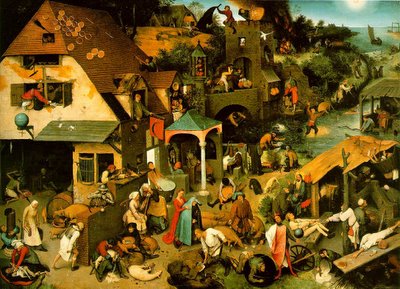
Thanks to Bvo I have made this post a little more clear. I found a website that listed the proverbs found in this picture, most of which I have listed here. Now see if you can find them:
"He runs his head against a stone wall"
"There the roof is tiled with tarts" (a land of plenty; a fool's paradise;)
"He has toothache behind his ears"
"Throwing roses before pigs."
"He is a pillar-biter" (a religious hypocrite)
"Big fish eat little fish"
"He is pissing against the moon"
"It depends on the fall of the cards."
"They both shit through one hole"
"It hangs like a privy over a ditch"
"He tosses feathers in the wind"
"One shears sheep, the other pigs"
"The world upside down"
"Two dogs over one bone seldom agree"
"He is looking for the hatchet" (an excuse)
"The world dances upon his thumb"
"Leave at least one egg in the nest"
"They pull to get the longest end"
"The pig is stabbed through the belly"
"To shoot all one’s bolts"
"To marry under the broomstick"
"He who has spilt his porridge cannot scrape it all up again"
"She carries fire in one hand and water in the other"
"He does not care whose house is on fire as long as he can warm himself at the blaze"
"One winds on the distaff what the other spins"
"To get the lid on the head" (to have to pay for the damages)
"To fry the whole herring for the sake of the meat"?
"She puts the blue mantle on her husband"
"He falls from the ox onto the ass"
"He carries the day out in baskets"
"He catches fish with his bare hands" (this shrewd fellow profits from the work of others by taking fish out of the nets which they have cast)
"Bow and scrape if he is to get on in the world."
"The herring hangs by its own gills"
"He holds a candle to the devil" (to make friends in all quarters)
"He plays on the pillory"
"Who knows why geese go barefoot?"
"He looks through his fingers" (he can afford to be indulgent because he is sure of his profit).
"They lead each other by the nose" (they are tricking each other).
"He confesses to the devil"
"She would bind the devil himself to a pillow."
"Fools get the best cards"
"He hangs his cloak according to the wind."
"There hangs the knife" (a challenge)
"He fills the well after the calf has drowned (measure taken only when an accident has occurred"
"There stand the wooden shoes" (to wait in vain)
"He wipes his arse on the door"
"Where the gate is open, the pigs will run into the corn"
"He carries a burden"
"He throws money into the water"
"The die is cast" (it is decided).
"Here the sow pulls out the stopper"
"He cannot bear to see the sun shine on the water"
"It is ill to swim against the stream"
"He sees bears dancing"
"He shits on the gallows"
"He falls through the basket" - rejected suitor
"She gazes at the stork"
"He ties a flaxen beard to the face of Christ"
"He shits on the world"
"He keeps his eye on the sail"
"To sit between two stools in the ashes"
"The hen-feeler" (“To count one’s chickens before they are hatched”)
"It is growing out of the window"
"He can barely reach from one loaf to the other"
"To shave the fool without lather"
"There the scissors hang out" (symbol of pickpocketing: a place of cheating and fleecing)
"No one looks for others in the oven who has not been there himself"
"He who eats fire. shits sparks"
"It is healthy to piss on the fire"
"He holds the eel by the tail"
"To put a spoke in someone's wheel"

Wednesday, February 15, 2006

Monday, February 13, 2006
I haven't been tagged, but this looked like fun:
Four Jobs I Have Had-
- Delivering newspapers
- Working with flowers and trees at a nursery
- Cutting grass in neighbourhoods and at a golf course
- Teaching ESL
Four Movies I Could Watch Over and Over-
- City of God
- Braveheart
- Crash
- The Godfather
Four Books I Could Read Over and Over-
- The Covenant - James A. Michener
- The Lord of the Rings - J.R.R. Tolkien
- The Power of One - Bryce Courtenay
- The War in 2020 - Ralph Peters (not even a great book, but it entertains me)
Places I Have Lived-
- Owen Sound, ON
- Hamilton, ON
- Ottawa, ON
- Gatineau, QC
Four Places I Have Been On Vacation-
- B.C.
- East Coast of Canada
- Florida
- Charlevoix and Quebec City (honeymoon)
Four Websites I Visit Daily-
- crooksandliars.com
- bbc news
- dictionary.com
- wikipedia.org
Four Favourite Foods-
- Hawaiian Pizza
- Hamburgers
- Sour Cream and Onion Ripple Chips
- Cold Raspberry Yogourt
Four Favourite Beers-
- Heineken
- Grolsch
- Corona
- Tuborg
Four Favourite Non-alcoholic Drinks
- Iced Tea
- Coca Cola Classic
- Grape Juice
- Cold Milk
Four Favourite Musicians-
- Bob Marley
- Buju Banton
- Ben Harper
- Wyclef Jean
Four Places I Would Like To Be Right Now-
- In bed.
- Floating in the water at a tropical beach.
- Accepting a cheque for a million dollars from some eccentric relative I never knew I had.
- Eating ribs.
Last four books you have read-
- Blindness - Jose Saramago
- Papillon - Henri Charriere
- Sun Tzu's Art of War -
- The Kite Runner - Khaled Hosseini
Last four movies you have seen-
- Sometimes in April (*****/*****)
- The Pink Panther (*/*****)
- The Bone Collector (**/*****)
- My Big Fat Greek Wedding (***/*****)
What's on your desk right now?
- A blank cd case
- Three empty glasses
- A Frank Lloyd Wright mousepad
- My elbow
Six- Seven bloggers you're tagging -
- Aaron Gysbers
- Daryl de Boer
- Todd Guthrie
- Piet Harsevoort
- Jake Belder
- Rob Joustra
- Marcellin Mutoni
Four Jobs I Have Had-
- Delivering newspapers
- Working with flowers and trees at a nursery
- Cutting grass in neighbourhoods and at a golf course
- Teaching ESL
Four Movies I Could Watch Over and Over-
- City of God
- Braveheart
- Crash
- The Godfather
Four Books I Could Read Over and Over-
- The Covenant - James A. Michener
- The Lord of the Rings - J.R.R. Tolkien
- The Power of One - Bryce Courtenay
- The War in 2020 - Ralph Peters (not even a great book, but it entertains me)
Places I Have Lived-
- Owen Sound, ON
- Hamilton, ON
- Ottawa, ON
- Gatineau, QC
Four Places I Have Been On Vacation-
- B.C.
- East Coast of Canada
- Florida
- Charlevoix and Quebec City (honeymoon)
Four Websites I Visit Daily-
- crooksandliars.com
- bbc news
- dictionary.com
- wikipedia.org
Four Favourite Foods-
- Hawaiian Pizza
- Hamburgers
- Sour Cream and Onion Ripple Chips
- Cold Raspberry Yogourt
Four Favourite Beers-
- Heineken
- Grolsch
- Corona
- Tuborg
Four Favourite Non-alcoholic Drinks
- Iced Tea
- Coca Cola Classic
- Grape Juice
- Cold Milk
Four Favourite Musicians-
- Bob Marley
- Buju Banton
- Ben Harper
- Wyclef Jean
Four Places I Would Like To Be Right Now-
- In bed.
- Floating in the water at a tropical beach.
- Accepting a cheque for a million dollars from some eccentric relative I never knew I had.
- Eating ribs.
Last four books you have read-
- Blindness - Jose Saramago
- Papillon - Henri Charriere
- Sun Tzu's Art of War -
- The Kite Runner - Khaled Hosseini
Last four movies you have seen-
- Sometimes in April (*****/*****)
- The Pink Panther (*/*****)
- The Bone Collector (**/*****)
- My Big Fat Greek Wedding (***/*****)
What's on your desk right now?
- A blank cd case
- Three empty glasses
- A Frank Lloyd Wright mousepad
- My elbow
Six- Seven bloggers you're tagging -
- Aaron Gysbers
- Daryl de Boer
- Todd Guthrie
- Piet Harsevoort
- Jake Belder
- Rob Joustra
- Marcellin Mutoni
Tuesday, February 07, 2006
Gustave
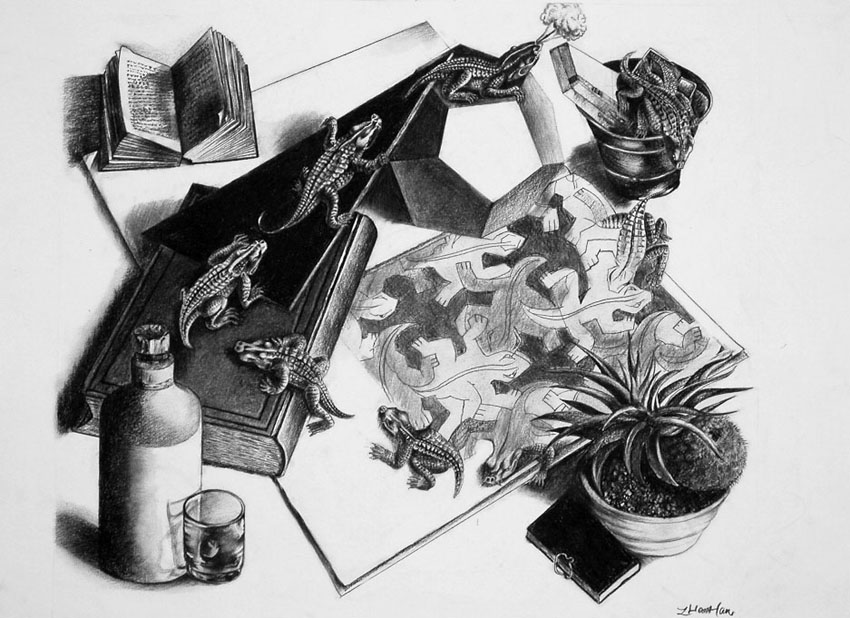
Crocodiles are ancient reptiles which are thought to have changed little since the time of the dinosaurs. Their sharp claws and fearsome jaws have been inspiring fear for thousands of years. These aquatic creatures love to loll in the slow-moving rivers and lakes of Africa, Asia, the Americas and Australia.
One particularly infamous crocodile has made his home on a river near Burundi's Lake Taganyika. Gustave is a crocodile who is said to measure six metres from snout to tail; a measurement which, even if exaggerated, puts him among the longest crocodiles of all time. The thing about Gustave is that he is a freshwater crocodile and his reported size rivals that of his saltwater cousins. Of course, that is only if Gustave is as long as people say he is.
The longest scientifically recorded crocodile was measured at 6.3 m on a crocodile killed on the Fly River in Papau New Guinea in 1983.
Of course, crocodiles, like fish, tend to grow the more people talk about them. A croc that was killed in the Bay of Bengal decades ago was said to be 10 m long. Later, the skull was measured by the British Museum and it was learned that the crocodile likely only measured 4.8 m. 5 metres is actually the average size of a full-grown saltwater crocodile. This crocodile, in other words, was no Gustave. Perhaps Gustave is no Gustave, for if his measurement doubled in the telling just as the length of the Bengalese croc did, we're really talking about a three metre crocodile which is nothing spectacular (unless you're being attacked, then it's pretty impressive).
Crocodiles tend to grow quite rapidly for the first fifteen years of their lives afterwhich they continue to grow at a much slower rate. Saltwater crocodiles commonly live to the ripe old age of seventy while freshwater crocodiles typically live to the age of fifty or sixty. A crocodile that died in Russia in 1997 was captured at the age of five or ten in 1890 which means he could have been as old as 115. More interesting, perhaps, is the fact that this crocodile's lifespan enveloped Russia's Communism quite comfortably and with a couple decades to spare.
Gustave's age is difficult to guess but it is safe to say that he's big for his age. A Frenchman by the name of Patrice Faye has been following Gustave for three or four years. It was Patrice who gave the crocodile his moniker "Gustave" in the first place. According to Monsieur Faye, the crocodile is particularly dangerous when he goes on his amorous adventures in search of feminine crocodilians: "One year I followed him on one of his forays and 17 people had been eaten from Kanyosha and Minago, and Kabezi and Magara." Now, this claim is difficult to substantiate as it is likely that Gustave gets credit for most of the crocodile killings along his routes. Nevertheless, Gustave is a dangerous old reptile and his reputation is one that causes quite a bit of fear among Burundian fisherman and bathers. Gustave is too slow to eat fish and small mammals and relies on larger and slower prey; namely humans. Sadly, Gustave has had many opportunities to gorge himself on dead corpses that have floated down his river.
Monsier Faye has made several attempts to capture Gustave but has failed. There have been a few attempts by Burundians to kill the crocodile as well but these, too, have failed. It is unknown how well the crocodile would fare in captivity, but hopefully he can develop a taste for beef.
Monday, February 06, 2006
Right now I'm listening to:
Elvis Presley - In the Ghetto
Otis Redding - Sitting on the Dock of the Bay
Eddie Vedder with Nusrat Fateh Ali Kahn - Long Road
The Beatles - Eleanor Rigby
Gordon Lightfoot - If You Could Read My Mind
Leonard Cohen - Hallelujah
2Face Idibia - African Queen
Any other recommendations?
Elvis Presley - In the Ghetto
Otis Redding - Sitting on the Dock of the Bay
Eddie Vedder with Nusrat Fateh Ali Kahn - Long Road
The Beatles - Eleanor Rigby
Gordon Lightfoot - If You Could Read My Mind
Leonard Cohen - Hallelujah
2Face Idibia - African Queen
Any other recommendations?
Sunday, February 05, 2006
Hamilton vs. Toronto and Ottawa
In response to this
Hamilton is better than both Toronto and Ottawa put together because . .
1) The Hamilton Farmer's Market on a Saturday because everyone knows that Kensington and Byward can't compete with an indoor market that has a mezzanine level.
2) Less stray bullets than Toronto and less stray politicians than Ottawa.
3) Bayfront Park is spectacular if you don't touch the water.
4) Unlike Ottawa or Toronto, Hamilton doesn't have a winter festival which will gradually peter out due to global warming.
5) Hamilton doesn't have a team named after aging grey-headed politicians nor do they have a team named after reptilian creatures which have absolutely nothing to do with their geographical location and have more to do with the popularity of a certain Spielberg movie.
6) Ottawa and Toronto may have won more Stanley Cups but they have yet to beat Hamilton for the number of festivals they have held which have met premature deaths.
7) Hamilton brought the world a few NHLers such as Dave Andreychuck but also, and more significantly, Hamilton is the hometown of Martin Short. Martin Short!
8) Ivor Wynne Stadium is honestly better for watching CFL games than either the Frank Clair Stadium or the Rogers Sports Centre.
9) The Plastimet fire was far more glorious (and toxic!) than the fire that took Ottawa's Parliament and the fires the American soldiers set in Toronto during the War of 1812.
10) Like those in Ottawa, Hamiltonians don't need help from the Canadian Army to shovel their snow. Unlike Ottawans, Hamiltonians actually shovel their snow.
11) Ottawa may be the capital of Canada and Toronto may be the capital of Ontario but Hamilton is the mullet capital of the world.
12) Unlike Torontonians, both Hamiltonians and Ottawans can get to work in under an hour each morning. Unlike Ottawans, Hamiltonians don't work cushy government jobs with expense accounts and ridiculously short hours.
13) Hamilton doesn't have Poutine, but they do have Canada's very first Tim Horton's restaurant. In fact, if you can't find a Tim Horton's branch in Hamilton than you're not in Hamilton.
14) Lawns in Toronto are postage-sized. Lawns in Ottawa and Hamilton are about equal size, but Hamilton has former Heritage Minister Sheila Copps and a lot more one-way streets which makes us that much more cultured and cosmopolitan.
15) Toronto's nickname? Hogtown. Ottawa's old nickname? Bytown. Hamilton's nickname? The Hammer (much cooler).
16) Do Toronto or Ottawa have a mountain? Neither does Hamilton, but it certainly has an escarpment/cuesta.
In response to this
Hamilton is better than both Toronto and Ottawa put together because . .
1) The Hamilton Farmer's Market on a Saturday because everyone knows that Kensington and Byward can't compete with an indoor market that has a mezzanine level.
2) Less stray bullets than Toronto and less stray politicians than Ottawa.
3) Bayfront Park is spectacular if you don't touch the water.
4) Unlike Ottawa or Toronto, Hamilton doesn't have a winter festival which will gradually peter out due to global warming.
5) Hamilton doesn't have a team named after aging grey-headed politicians nor do they have a team named after reptilian creatures which have absolutely nothing to do with their geographical location and have more to do with the popularity of a certain Spielberg movie.
6) Ottawa and Toronto may have won more Stanley Cups but they have yet to beat Hamilton for the number of festivals they have held which have met premature deaths.
7) Hamilton brought the world a few NHLers such as Dave Andreychuck but also, and more significantly, Hamilton is the hometown of Martin Short. Martin Short!
8) Ivor Wynne Stadium is honestly better for watching CFL games than either the Frank Clair Stadium or the Rogers Sports Centre.
9) The Plastimet fire was far more glorious (and toxic!) than the fire that took Ottawa's Parliament and the fires the American soldiers set in Toronto during the War of 1812.
10) Like those in Ottawa, Hamiltonians don't need help from the Canadian Army to shovel their snow. Unlike Ottawans, Hamiltonians actually shovel their snow.
11) Ottawa may be the capital of Canada and Toronto may be the capital of Ontario but Hamilton is the mullet capital of the world.
12) Unlike Torontonians, both Hamiltonians and Ottawans can get to work in under an hour each morning. Unlike Ottawans, Hamiltonians don't work cushy government jobs with expense accounts and ridiculously short hours.
13) Hamilton doesn't have Poutine, but they do have Canada's very first Tim Horton's restaurant. In fact, if you can't find a Tim Horton's branch in Hamilton than you're not in Hamilton.
14) Lawns in Toronto are postage-sized. Lawns in Ottawa and Hamilton are about equal size, but Hamilton has former Heritage Minister Sheila Copps and a lot more one-way streets which makes us that much more cultured and cosmopolitan.
15) Toronto's nickname? Hogtown. Ottawa's old nickname? Bytown. Hamilton's nickname? The Hammer (much cooler).
16) Do Toronto or Ottawa have a mountain? Neither does Hamilton, but it certainly has an escarpment/cuesta.
To all those who find my site inquisitive and would like me to look at their site:
Thank you for you kind words and for your interest in my site. Somehow, unfortunately, I am doubting the sincerity of your admiration. I received the following double-posted comment from a fellow by the name of markericks1317666745: "I read over your blog, and i found it inquisitive, you may find My Blog interesting. So please Click Here To Read My Blog http://pennystockinvestment.blogspot.com "
First of all, what are you doing posting at 4:15 in the morning? Secondly, your blog is nonexistent and so the implication that I might find your blog as interesting as you found mine is actually pretty hurtful. I should hope my blog is more interesting than something which is "not found."
Davidalexander9507 left the following comment "I read over your blog, and i found it inquisitive, you may find My Blog interesting. My blog is just about my day to day life, as a park ranger. So please Click Here To Read My Blog "
Now, davidalexander9507 and markericks1317666745 might not be related but their comments are similar to the point of being identical. All davidalexander9507 added was this little tidbit "My blog is just about my day to day life, as a park ranger." I thought maybe it was a coincidence that these two individuals express their interest in the same way, but then I found a common thread. The name of the first blog is pennystockinvestment.blogspot.com while one of davidalexander9507's posts reads as follows: "
He is a broker in some firm, whatever. Being a park ranger he knows I am big for the environment and all that good stuff, and knows I have some extra cash saved up that said I wanted to invest in something (I've been very vague). ANYWAY, he goes on and tells me about one very specific stock..this company that creates a special type of tree; that regrows from the stump when cut, and grows at a very fast rate, great for the environment to say the least.
I'm not very good with stocks...well, I should say I don't know anything about them. But I looked at the stock today, and the damn thing is up 166%! I might buy a thousand shares (only about $100 bucks or so) and see how it turns out. Yes, I know I can lose all my investment, but wow, looks damn good!
Any stock people out there can assist me? Check the details of it here. If your good with stocks toss me an email to juicy_fruiter@yahoo.com, I'd like to know if it is as good as I think it is."
What is the common denominator? If you said pennystocks than you're on the right track. Anyone else want to invest in trees that grow from the stump at a very fast rate after being cut? They're very good for the environment, to say the least. Davidalexander9507 also has an interest in Juicy Fruit gum and a free downloadable program called Motivation which can be downloaded at www.filequota.com.
In addition, I think I should point out that the word "inquisitive" is an adjective which describes someone who is curious. A blogsite, being an inanimate object, does not have the capacity to be inquisitive. If it did, we would soon find that blogs would be seriously unfulfilled as they are unable to search for knowledge to sate their curiousity.
Thank you for you kind words and for your interest in my site. Somehow, unfortunately, I am doubting the sincerity of your admiration. I received the following double-posted comment from a fellow by the name of markericks1317666745: "I read over your blog, and i found it inquisitive, you may find My Blog interesting. So please Click Here To Read My Blog http://pennystockinvestment.blogspot.com "
First of all, what are you doing posting at 4:15 in the morning? Secondly, your blog is nonexistent and so the implication that I might find your blog as interesting as you found mine is actually pretty hurtful. I should hope my blog is more interesting than something which is "not found."
Davidalexander9507 left the following comment "I read over your blog, and i found it inquisitive, you may find My Blog interesting. My blog is just about my day to day life, as a park ranger. So please Click Here To Read My Blog "
Now, davidalexander9507 and markericks1317666745 might not be related but their comments are similar to the point of being identical. All davidalexander9507 added was this little tidbit "My blog is just about my day to day life, as a park ranger." I thought maybe it was a coincidence that these two individuals express their interest in the same way, but then I found a common thread. The name of the first blog is pennystockinvestment.blogspot.com while one of davidalexander9507's posts reads as follows: "
Stocks? I don't know...
Today a friend of mine confronted me about investing in some penny stocks.....what?He is a broker in some firm, whatever. Being a park ranger he knows I am big for the environment and all that good stuff, and knows I have some extra cash saved up that said I wanted to invest in something (I've been very vague). ANYWAY, he goes on and tells me about one very specific stock..this company that creates a special type of tree; that regrows from the stump when cut, and grows at a very fast rate, great for the environment to say the least.
I'm not very good with stocks...well, I should say I don't know anything about them. But I looked at the stock today, and the damn thing is up 166%! I might buy a thousand shares (only about $100 bucks or so) and see how it turns out. Yes, I know I can lose all my investment, but wow, looks damn good!
Any stock people out there can assist me? Check the details of it here. If your good with stocks toss me an email to juicy_fruiter@yahoo.com, I'd like to know if it is as good as I think it is."
What is the common denominator? If you said pennystocks than you're on the right track. Anyone else want to invest in trees that grow from the stump at a very fast rate after being cut? They're very good for the environment, to say the least. Davidalexander9507 also has an interest in Juicy Fruit gum and a free downloadable program called Motivation which can be downloaded at www.filequota.com.
In addition, I think I should point out that the word "inquisitive" is an adjective which describes someone who is curious. A blogsite, being an inanimate object, does not have the capacity to be inquisitive. If it did, we would soon find that blogs would be seriously unfulfilled as they are unable to search for knowledge to sate their curiousity.
Friday, February 03, 2006
What Hath God Wrought?
Today I read that the Western Union telegram had finally met its demise after one hundred and fifty years of service. I was under the impression that the telegram had gone the way of the dodo bird around the same time that records started to be cool. Nope, the telegram was still clicking away as recently as February 1, 2006. In fact, the Swedish Company Telia still sends telegrams and nostalgic novelty items. I suppose that means that telegrams have not yet completely died and the reports of its death have been greatly exaggerated.
In other technological news, the United States is set to switch off the televisions of over seventy million viewers from around the country. February 17, 2009 is the proposed date for the end of the broadcasting of analog signals. Canada may soon follow suit and grandpa and grandma's television will fade to black. Once the spectrum is free it will be sold off to tech companies who can use it for improved cell phone, wireless access and other such technological mumbo jumbo. The American government is proposing vouchers for those who rely on VHF/UHF signals so that they can purchase digital or cable access. This has some in the Canadian Liberal Party asking, "what is to stop these people from spending this money on popcorn and beer?" Perhaps a revolution will occur in which thousands of souls stuck at home watching fuzzy re-runs of That 70's Show will suddenly be inspired to visit their local library and read some books.
Today I read that the Western Union telegram had finally met its demise after one hundred and fifty years of service. I was under the impression that the telegram had gone the way of the dodo bird around the same time that records started to be cool. Nope, the telegram was still clicking away as recently as February 1, 2006. In fact, the Swedish Company Telia still sends telegrams and nostalgic novelty items. I suppose that means that telegrams have not yet completely died and the reports of its death have been greatly exaggerated.
In other technological news, the United States is set to switch off the televisions of over seventy million viewers from around the country. February 17, 2009 is the proposed date for the end of the broadcasting of analog signals. Canada may soon follow suit and grandpa and grandma's television will fade to black. Once the spectrum is free it will be sold off to tech companies who can use it for improved cell phone, wireless access and other such technological mumbo jumbo. The American government is proposing vouchers for those who rely on VHF/UHF signals so that they can purchase digital or cable access. This has some in the Canadian Liberal Party asking, "what is to stop these people from spending this money on popcorn and beer?" Perhaps a revolution will occur in which thousands of souls stuck at home watching fuzzy re-runs of That 70's Show will suddenly be inspired to visit their local library and read some books.
Tuesday, January 31, 2006
Update:
- Dr. Koyzis but an HRH in front of my name on his blog site and I just noticed.
- This weekend I went to see Bedouin Soundclash, an inspiring reggae-tinged band.
- Their audience, made up primarily of inebriated first-year university students, was rather uninspiring.
- When you can formulate the following sentence you need to ask yourself whether ESL is really necessary for you: The woman had difficulty obtaining a job due to the rather large carnivorous appendage growing from her forehead.
- On Sunday I drag-raced a gas truck during a snow storm and it crashed and exploded in a ball of fire.
- The previous statement was inspired by James Frey's memoir and represents my personal and emotional truth. I did pass a gas truck on the highway during a snow storm but it didn't actually crash, although he might have pulled over because the weather was rather horrid.
- Fingernail, sigh.
- Perhaps I was too hard on Nickelback, after all there is a lot of music out there that is far far worse.
- I'm looking at you, Mr. Masari.
- When you have an HRH in front of your name you have a certain sense of entitlement.
- I visited Rideau Hall on Friday and was astounded at how small it was originally under the ownership of Thomas Mckay. Too bad I couldn't find a picture.
- One of my students pointed out that his house was taller than the South African embassy.
- The South African embassy is pretty darn tall.
- Apparently it helps sales when Osama bin Laden recommends your book, but I'm sure it does little for your reputation.
- Of course a lot of Americans would stop eating bow-tie pasta if they found out that it was Osama's favourite.
- Bow-tie pasta, of course, is fairly benign in comparison to something which communicates ideas.
- Still, Osama often highjacks legitimate criticisms of American policy and mixes them into his volatile ideology.
- Read a classic short story on the web sometime.
- A social and moral conscience is not the exclusive domain of those who are considered "right-wing", nor is equality, social justice, and international cooperation the exclusive domain of those who are considered "left-wing."
- When I was young I thought the Quaker icon on Harvest Crunch was a jolly old fat woman.
- I astonished to learn that Romeo LeBlanc removed the claws and to ngue from the flag of the governor general of Canada. Why? Too scary, I guess.
- Does this picture scare you? See how menacingly he brandishes that maple leaf?
- Adrienne Clarkson had the neutering reversed.
- At the age of eight or nine I came to the sudden realization that the quaker was a man and that he had, no doubt, helped Aunt Jemima and Uncle Ben escape from Col. Sanders.
- Actually, Col. Sanders wasn't part of the equation.
- Last Friday, I hurled a large boulder of ice and snow into the water just above Rideau Falls with the help of a Chinese tourist and an enthusiastic eleven-year-old ESL student.
- I'm not certain that boulder hurling is an appropriate activity for a professional.
- Michaëlle Jean was home when I went to Rideau Hall, but I didn't see her.
- When Stephen Harper tells off the American ambassador is that anti-Americanism? I don't know because apparently Conservatives are opposed to that sort of thing.
- Actually, he made me rather proud with his mature and dignified response which can be contrasted favourably with Paul Martin's wild posturing over Kyoto (I agree with his supposed stance but not his approach).
- I cannot believe that PETA activists compare themselves with civil rights workers.
- Ndagu Kunda cane, Laurianne.
- Dr. Koyzis but an HRH in front of my name on his blog site and I just noticed.
- This weekend I went to see Bedouin Soundclash, an inspiring reggae-tinged band.
- Their audience, made up primarily of inebriated first-year university students, was rather uninspiring.
- When you can formulate the following sentence you need to ask yourself whether ESL is really necessary for you: The woman had difficulty obtaining a job due to the rather large carnivorous appendage growing from her forehead.
- On Sunday I drag-raced a gas truck during a snow storm and it crashed and exploded in a ball of fire.
- The previous statement was inspired by James Frey's memoir and represents my personal and emotional truth. I did pass a gas truck on the highway during a snow storm but it didn't actually crash, although he might have pulled over because the weather was rather horrid.
- Fingernail, sigh.
- Perhaps I was too hard on Nickelback, after all there is a lot of music out there that is far far worse.
- I'm looking at you, Mr. Masari.
- When you have an HRH in front of your name you have a certain sense of entitlement.
- I visited Rideau Hall on Friday and was astounded at how small it was originally under the ownership of Thomas Mckay. Too bad I couldn't find a picture.
- One of my students pointed out that his house was taller than the South African embassy.
- The South African embassy is pretty darn tall.
- Apparently it helps sales when Osama bin Laden recommends your book, but I'm sure it does little for your reputation.
- Of course a lot of Americans would stop eating bow-tie pasta if they found out that it was Osama's favourite.
- Bow-tie pasta, of course, is fairly benign in comparison to something which communicates ideas.
- Still, Osama often highjacks legitimate criticisms of American policy and mixes them into his volatile ideology.
- Read a classic short story on the web sometime.
- A social and moral conscience is not the exclusive domain of those who are considered "right-wing", nor is equality, social justice, and international cooperation the exclusive domain of those who are considered "left-wing."
- When I was young I thought the Quaker icon on Harvest Crunch was a jolly old fat woman.
- I astonished to learn that Romeo LeBlanc removed the claws and to
 ngue from the flag of the governor general of Canada. Why? Too scary, I guess.
- Does this picture scare you? See how menacingly he brandishes that maple leaf?
- Adrienne Clarkson had the neutering reversed.
- At the age of eight or nine I came to the sudden realization that the quaker was a man and that he had, no doubt, helped Aunt Jemima and Uncle Ben escape from Col. Sanders.
- Actually, Col. Sanders wasn't part of the equation.
- Last Friday, I hurled a large boulder of ice and snow into the water just above Rideau Falls with the help of a Chinese tourist and an enthusiastic eleven-year-old ESL student.
- I'm not certain that boulder hurling is an appropriate activity for a professional.
- Michaëlle Jean was home when I went to Rideau Hall, but I didn't see her.
- When Stephen Harper tells off the American ambassador is that anti-Americanism? I don't know because apparently Conservatives are opposed to that sort of thing.
- Actually, he made me rather proud with his mature and dignified response which can be contrasted favourably with Paul Martin's wild posturing over Kyoto (I agree with his supposed stance but not his approach).
- I cannot believe that PETA activists compare themselves with civil rights workers.
- Ndagu Kunda cane, Laurianne.
Tuesday, January 24, 2006
I remember when Nickelback came out and I assumed that they were another flash-in-the-pan Canadian content filler. Well, they have proved me wrong, but I kind of wish that they never did. If you close your eyes and listen to Nickelback you might be convinced that Cher went heavy petal (my clever title for this unique heavy-metal-pop hybrid). The earnest forced vocals of Chad Kroeger make him sound as if he is singing while perched atop a porcelain throne after consuming too many bran muffins. Now, I am completely unaware of this group's full catalogue, but everything I hear on the radio makes me wince. The following is a deconstruction of their popular song, "Photograph":
Look at this photograph
Everytime I do it makes me laugh
How did our eyes get so red
And what the hell is on Joey's head
Very good, graph rhymes with laugh. Maybe you can describe the picture a little more because I don't understand how red-eye can be construed as humorous. If poor photography strikes you as funny, you should see Miss Weston's grade four class' photography contest which would undoubtedly be a veritable gold mine of humour for you. And that thing on Joey's head? That's called a mullet, the legacy of your generation.
And this is where I grew up
I think the present owner fixed it up
I never knew we'd ever went without
The second floor is hard for sneaking out
Unfortunately, up only rhymes with up because they are the same word which, technically, means that they don't actually rhyme. The verse begins on the subject of the house and ends on the subject of the house but the third line suddenly inserts this random thought: "I never knew we'd ever went without." I suppose you can connect your home to your socio-economic status, but from the music video the house looks pretty nice. I mean, even if it was in a fairly poor state before the present owner fixed it up we're still talking about a nice two-story middle-class home. Maybe you didn't receive all of the flashy electronic gifts your friends got for Christmas but your parents cared enough about you to make it difficult for you to sneak out of your home at night.
And this is where I went to school
Most of the time had better things to do
Criminal record says I've broke in twice
I must have done it half a dozen times
School and do don't rhyme but they do have assonance, which I suppose is more acceptable than trying to rhyme up with up. What did you have to do that was more important than going to school? Maybe you can fill us in on this later, what's more important now is that you broke into your school. The idea that you broke into your school a half a dozen times doesn't blend well with the idea that you ostensibly had better things to do than go to school. Apparently, you were so desperate for school that you broke into school during your spare time. Not only that, but you were so bad at breaking into your school that you were caught one third of the time.
I wonder if it's too late
Should I go back and try to graduate
Life's better now than it was back then
If I was them I wouldn't let me in
It is never too late to graduate, Chad, or to take some remedial English courses. So life's better now than it was back then? I'll assume you're speaking economically because the whole song consists of you waxing poetic on how many great memories you have of growing up. So here you go again, complaining about your socio-economic problems when it is clear from a latter section of the song that you at least had access to a vehicle as a youngster which makes the whole complaint about how bad things were back then fall kind of flat. I wouldn't worry about them not letting you into school, because I'm sure that you have earned enough money off of your heavy petal music to hire a tutor.
Oh oh oh oh Oh God I, I
Every memory of looking out the back door
I have the photo album spread out on my bedroom floor
It's hard to say it, time to say it
Goodbye goodbye
Every memory of walking out the front door
I found the photo of the friend I was looking for
It's hard to say it, time to say it
Goodbye goodbye
God? What does he have to do with it? Nothing? Oh, okay, you just thought it sounded kind of cool to invoke his name? Oh, I see now. "Every memory of looking out the back door" and "every memory of walking out the front door" are sentence fragments which I'll forgive if you explain to me whether you're saying goodbye to your friends, your memories, your photo album, or the photo of the friend that you were looking for. Are you contemplating suicide? I contemplate radiocide everytime I hear this song. I usually just turn it off, though, because I'm not a violent person.
Remember the old arcade
Blew every dollar that we ever made
The cops hated us hanging out
They say somebody went and burned it down
Let me see if I understand this correctly, because earlier you said that you didn't go to school because most of the time you had better things to do. Basically, you're saying that playing pong or pinball was more important than going to school? I can understand that it was more fun to do that a couple times a month but if you did that most of the time it would get pretty lame after a while. Also, I don't know which town in Alberta has an arcade where the cool kids hang out, but here in Ontario we have this stigma attached to arcades where it is, you know, sort of a place for the geeky types --- not that there is anything wrong with being a geek. I find it difficult to picture the cops coming down hard on arcade nerds, but maybe you have a photograph of this that can help me out here. I should also add that when you follow the line about the cops hating you for hanging out at the arcade with a line about somebody burning it down it seems to imply that the police had a hand in the arson. Okay, I'm being facetious, but it's kind of fun.
We used to listen to the radio
And sing along with every song we know
We said someday we'd find out how it feels
To sing to more than just the steering wheel
Radio and know do rhyme, but since you're talking about something that occurred in the past, know should be knew which, incidentally, doesn't rhyme with radio. Hey, wow, you found out how it feels to sing to more than just a steering wheel! How does it feel? Because for me it's pretty torturous and it makes me wish that you were once again serenading inanimate objects.
Kim's the first girl I kissed
I was so nervous that I nearly missed
She's had a couple of kids since then
I haven't seen her since God knows when
I can relate to nearly missing on the first kiss so I can't actually make fun of that. Although, I suppose those who preach abstinence could reference your song when talking about the slippery slide of intimacy. I mean, Kim kissed you, and now look where she is, with two kids in the middle of who-knows-where. Ladies, take note, you need to resist the urge to kiss arcade geeks until after you're married to them.
I miss that town I miss the faces
You can't erase You can't replace it
I miss it now I can't believe it
So hard to stay Too hard to leave it
If you miss the town, why is it so hard to stay while at the same time being too hard to leave? I can't believe it either.
If I could relive those days
I know the one thing that would never change,
What would never change? Your educational abandonment? The arcade arson? Joey's mullet? I know that you repeat the chorus at this point but there's nothing in there that you could possibly be referring to.
Also, I don't like your goatee.
Look at this photograph
Everytime I do it makes me laugh
How did our eyes get so red
And what the hell is on Joey's head
Very good, graph rhymes with laugh. Maybe you can describe the picture a little more because I don't understand how red-eye can be construed as humorous. If poor photography strikes you as funny, you should see Miss Weston's grade four class' photography contest which would undoubtedly be a veritable gold mine of humour for you. And that thing on Joey's head? That's called a mullet, the legacy of your generation.
And this is where I grew up
I think the present owner fixed it up
I never knew we'd ever went without
The second floor is hard for sneaking out
Unfortunately, up only rhymes with up because they are the same word which, technically, means that they don't actually rhyme. The verse begins on the subject of the house and ends on the subject of the house but the third line suddenly inserts this random thought: "I never knew we'd ever went without." I suppose you can connect your home to your socio-economic status, but from the music video the house looks pretty nice. I mean, even if it was in a fairly poor state before the present owner fixed it up we're still talking about a nice two-story middle-class home. Maybe you didn't receive all of the flashy electronic gifts your friends got for Christmas but your parents cared enough about you to make it difficult for you to sneak out of your home at night.
And this is where I went to school
Most of the time had better things to do
Criminal record says I've broke in twice
I must have done it half a dozen times
School and do don't rhyme but they do have assonance, which I suppose is more acceptable than trying to rhyme up with up. What did you have to do that was more important than going to school? Maybe you can fill us in on this later, what's more important now is that you broke into your school. The idea that you broke into your school a half a dozen times doesn't blend well with the idea that you ostensibly had better things to do than go to school. Apparently, you were so desperate for school that you broke into school during your spare time. Not only that, but you were so bad at breaking into your school that you were caught one third of the time.
I wonder if it's too late
Should I go back and try to graduate
Life's better now than it was back then
If I was them I wouldn't let me in
It is never too late to graduate, Chad, or to take some remedial English courses. So life's better now than it was back then? I'll assume you're speaking economically because the whole song consists of you waxing poetic on how many great memories you have of growing up. So here you go again, complaining about your socio-economic problems when it is clear from a latter section of the song that you at least had access to a vehicle as a youngster which makes the whole complaint about how bad things were back then fall kind of flat. I wouldn't worry about them not letting you into school, because I'm sure that you have earned enough money off of your heavy petal music to hire a tutor.
Oh oh oh oh Oh God I, I
Every memory of looking out the back door
I have the photo album spread out on my bedroom floor
It's hard to say it, time to say it
Goodbye goodbye
Every memory of walking out the front door
I found the photo of the friend I was looking for
It's hard to say it, time to say it
Goodbye goodbye
God? What does he have to do with it? Nothing? Oh, okay, you just thought it sounded kind of cool to invoke his name? Oh, I see now. "Every memory of looking out the back door" and "every memory of walking out the front door" are sentence fragments which I'll forgive if you explain to me whether you're saying goodbye to your friends, your memories, your photo album, or the photo of the friend that you were looking for. Are you contemplating suicide? I contemplate radiocide everytime I hear this song. I usually just turn it off, though, because I'm not a violent person.
Remember the old arcade
Blew every dollar that we ever made
The cops hated us hanging out
They say somebody went and burned it down
Let me see if I understand this correctly, because earlier you said that you didn't go to school because most of the time you had better things to do. Basically, you're saying that playing pong or pinball was more important than going to school? I can understand that it was more fun to do that a couple times a month but if you did that most of the time it would get pretty lame after a while. Also, I don't know which town in Alberta has an arcade where the cool kids hang out, but here in Ontario we have this stigma attached to arcades where it is, you know, sort of a place for the geeky types --- not that there is anything wrong with being a geek. I find it difficult to picture the cops coming down hard on arcade nerds, but maybe you have a photograph of this that can help me out here. I should also add that when you follow the line about the cops hating you for hanging out at the arcade with a line about somebody burning it down it seems to imply that the police had a hand in the arson. Okay, I'm being facetious, but it's kind of fun.
We used to listen to the radio
And sing along with every song we know
We said someday we'd find out how it feels
To sing to more than just the steering wheel
Radio and know do rhyme, but since you're talking about something that occurred in the past, know should be knew which, incidentally, doesn't rhyme with radio. Hey, wow, you found out how it feels to sing to more than just a steering wheel! How does it feel? Because for me it's pretty torturous and it makes me wish that you were once again serenading inanimate objects.
Kim's the first girl I kissed
I was so nervous that I nearly missed
She's had a couple of kids since then
I haven't seen her since God knows when
I can relate to nearly missing on the first kiss so I can't actually make fun of that. Although, I suppose those who preach abstinence could reference your song when talking about the slippery slide of intimacy. I mean, Kim kissed you, and now look where she is, with two kids in the middle of who-knows-where. Ladies, take note, you need to resist the urge to kiss arcade geeks until after you're married to them.
I miss that town I miss the faces
You can't erase You can't replace it
I miss it now I can't believe it
So hard to stay Too hard to leave it
If you miss the town, why is it so hard to stay while at the same time being too hard to leave? I can't believe it either.
If I could relive those days
I know the one thing that would never change,
What would never change? Your educational abandonment? The arcade arson? Joey's mullet? I know that you repeat the chorus at this point but there's nothing in there that you could possibly be referring to.
Also, I don't like your goatee.
Sunday, January 22, 2006
When I was young, I knew that my parents had all the answers. As I grew, I began to suspect that the answers lay in books. By the age of twelve I had all of the answers. Time passed and I soon learned that most of my answers were flawed and so I strove to re-educate myself on the answers. In University I learned to deconstruct answers and became quite adept at scoffing at other people's answers. Now, I continue to look for answers, but cling to the one my parents taught me from the beginning.
Monday, January 16, 2006
Al Gore's Martin Luther King Day Speech
Al Gore, love him or hate him, made what I feel is a very important speech today. Whatever you political beliefs, please read it:
"Congressman Barr and I have disagreed many times over the years, but we have joined together today with thousands of our fellow citizens-Democrats and Republicans alike-to express our shared concern that America's Constitution is in grave danger.
In spite of our differences over ideology and politics, we are in strong agreement that the American values we hold most dear have been placed at serious risk by the unprecedented claims of the Administration to a truly breathtaking expansion of executive power.
As we begin this new year, the Executive Branch of our government has been caught eavesdropping on huge numbers of American citizens and has brazenly declared that it has the unilateral right to continue without regard to the established law enacted by Congress to prevent such abuses.
It is imperative that respect for the rule of law be restored.
So, many of us have come here to Constitution Hall to sound an alarm and call upon our fellow citizens to put aside partisan differences and join with us in demanding that our Constitution be defended and preserved.
It is appropriate that we make this appeal on the day our nation has set aside to honor the life and legacy of Dr. Martin Luther King, Jr., who challenged America to breathe new life into our oldest values by extending its promise to all our people.
On this particular Martin Luther King Day, it is especially important to recall that for the last several years of his life, Dr. King was illegally wiretapped-one of hundreds of thousands of Americans whose private communications were intercepted by the U.S. government during this period.
The FBI privately called King the "most dangerous and effective negro leader in the country" and vowed to "take him off his pedestal." The government even attempted to destroy his marriage and blackmail him into committing suicide.
This campaign continued until Dr. King's murder. The discovery that the FBI conducted a long-running and extensive campaign of secret electronic surveillance designed to infiltrate the inner workings of the Southern Christian Leadership Conference, and to learn the most intimate details of Dr. King's life, helped to convince Congress to enact restrictions on wiretapping.
The result was the Foreign Intelligence and Surveillance Act (FISA), which was enacted expressly to ensure that foreign intelligence surveillance would be presented to an impartial judge to verify that there is a sufficient cause for the surveillance. I voted for that law during my first term in Congress and for almost thirty years the system has proven a workable and valued means of according a level of protection for private citizens, while permitting foreign surveillance to continue.
Yet, just one month ago, Americans awoke to the shocking news that in spite of this long settled law, the Executive Branch has been secretly spying on large numbers of Americans for the last four years and eavesdropping on "large volumes of telephone calls, e-mail messages, and other Internet traffic inside the United States." The New York Times reported that the President decided to launch this massive eavesdropping program "without search warrants or any new laws that would permit such domestic intelligence collection."
During the period when this eavesdropping was still secret, the President went out of his way to reassure the American people on more than one occasion that, of course, judicial permission is required for any government spying on American citizens and that, of course, these constitutional safeguards were still in place.
But surprisingly, the President's soothing statements turned out to be false. Moreover, as soon as this massive domestic spying program was uncovered by the press, the President not only confirmed that the story was true, but also declared that he has no intention of bringing these wholesale invasions of privacy to an end.
At present, we still have much to learn about the NSA's domestic surveillance. What we do know about this pervasive wiretapping virtually compels the conclusion that the President of the United States has been breaking the law repeatedly and persistently.
A president who breaks the law is a threat to the very structure of our government. Our Founding Fathers were adamant that they had established a government of laws and not men. Indeed, they recognized that the structure of government they had enshrined in our Constitution - our system of checks and balances - was designed with a central purpose of ensuring that it would govern through the rule of law. As John Adams said: "The executive shall never exercise the legislative and judicial powers, or either of them, to the end that it may be a government of laws and not of men."
An executive who arrogates to himself the power to ignore the legitimate legislative directives of the Congress or to act free of the check of the judiciary becomes the central threat that the Founders sought to nullify in the Constitution - an all-powerful executive too reminiscent of the King from whom they had broken free. In the words of James Madison, "the accumulation of all powers, legislative, executive, and judiciary, in the same hands, whether of one, a few, or many, and whether hereditary, self-appointed, or elective, may justly be pronounced the very definition of tyranny."
Thomas Paine, whose pamphlet, "On Common Sense" ignited the American Revolution, succinctly described America's alternative. Here, he said, we intended to make certain that "the law is king."
Vigilant adherence to the rule of law strengthens our democracy and strengthens America. It ensures that those who govern us operate within our constitutional structure, which means that our democratic institutions play their indispensable role in shaping policy and determining the direction of our nation. It means that the people of this nation ultimately determine its course and not executive officials operating in secret without constraint.
The rule of law makes us stronger by ensuring that decisions will be tested, studied, reviewed and examined through the processes of government that are designed to improve policy. And the knowledge that they will be reviewed prevents over-reaching and checks the accretion of power.
A commitment to openness, truthfulness and accountability also helps our country avoid many serious mistakes. Recently, for example, we learned from recently classified declassified documents that the Gulf of Tonkin Resolution, which authorized the tragic Vietnam war, was actually based on false information. We now know that the decision by Congress to authorize the Iraq War, 38 years later, was also based on false information. America would have been better off knowing the truth and avoiding both of these colossal mistakes in our history. Following the rule of law makes us safer, not more vulnerable.
The President and I agree on one thing. The threat from terrorism is all too real. There is simply no question that we continue to face new challenges in the wake of the attack on September 11th and that we must be ever-vigilant in protecting our citizens from harm.
Where we disagree is that we have to break the law or sacrifice our system of government to protect Americans from terrorism. In fact, doing so makes us weaker and more vulnerable.
Once violated, the rule of law is in danger. Unless stopped, lawlessness grows. The greater the power of the executive grows, the more difficult it becomes for the other branches to perform their constitutional roles. As the executive acts outside its constitutionally prescribed role and is able to control access to information that would expose its actions, it becomes increasingly difficult for the other branches to police it. Once that ability is lost, democracy itself is threatened and we become a government of men and not laws.
The President's men have minced words about America's laws. The Attorney General openly conceded that the "kind of surveillance" we now know they have been conducting requires a court order unless authorized by statute. The Foreign Intelligence Surveillance Act self-evidently does not authorize what the NSA has been doing, and no one inside or outside the Administration claims that it does. Incredibly, the Administration claims instead that the surveillance was implicitly authorized when Congress voted to use force against those who attacked us on September 11th.
This argument just does not hold any water. Without getting into the legal intricacies, it faces a number of embarrassing facts. First, another admission by the Attorney General: he concedes that the Administration knew that the NSA project was prohibited by existing law and that they consulted with some members of Congress about changing the statute. Gonzalez says that they were told this probably would not be possible. So how can they now argue that the Authorization for the Use of Military Force somehow implicitly authorized it all along? Second, when the Authorization was being debated, the Administration did in fact seek to have language inserted in it that would have authorized them to use military force domestically - and the Congress did not agree. Senator Ted Stevens and Representative Jim McGovern, among others, made statements during the Authorization debate clearly restating that that Authorization did not operate domestically.
When President Bush failed to convince Congress to give him all the power he wanted when they passed the AUMF, he secretly assumed that power anyway, as if congressional authorization was a useless bother. But as Justice Frankfurter once wrote: "To find authority so explicitly withheld is not merely to disregard in a particular instance the clear will of Congress. It is to disrespect the whole legislative process and the constitutional division of authority between President and Congress."
This is precisely the "disrespect" for the law that the Supreme Court struck down in the steel seizure case.
It is this same disrespect for America's Constitution which has now brought our republic to the brink of a dangerous breach in the fabric of the Constitution. And the disrespect embodied in these apparent mass violations of the law is part of a larger pattern of seeming indifference to the Constitution that is deeply troubling to millions of Americans in both political parties.
For example, the President has also declared that he has a heretofore unrecognized inherent power to seize and imprison any American citizen that he alone determines to be a threat to our nation, and that, notwithstanding his American citizenship, the person imprisoned has no right to talk with a lawyer-even to argue that the President or his appointees have made a mistake and imprisoned the wrong person.
The President claims that he can imprison American citizens indefinitely for the rest of their lives without an arrest warrant, without notifying them about what charges have been filed against them, and without informing their families that they have been imprisoned.
At the same time, the Executive Branch has claimed a previously unrecognized authority to mistreat prisoners in its custody in ways that plainly constitute torture in a pattern that has now been documented in U.S. facilities located in several countries around the world.
Over 100 of these captives have reportedly died while being tortured by Executive Branch interrogators and many more have been broken and humiliated. In the notorious Abu Ghraib prison, investigators who documented the pattern of torture estimated that more than 90 percent of the victims were innocent of any charges.
This shameful exercise of power overturns a set of principles that our nation has observed since General Washington first enunciated them during our Revolutionary War and has been observed by every president since then - until now. These practices violate the Geneva Conventions and the International Convention Against Torture, not to mention our own laws against torture.
The President has also claimed that he has the authority to kidnap individuals in foreign countries and deliver them for imprisonment and interrogation on our behalf by autocratic regimes in nations that are infamous for the cruelty of their techniques for torture.
Some of our traditional allies have been shocked by these new practices on the part of our nation. The British Ambassador to Uzbekistan - one of those nations with the worst reputations for torture in its prisons - registered a complaint to his home office about the senselessness and cruelty of the new U.S. practice: "This material is useless - we are selling our souls for dross. It is in fact positively harmful."
Can it be true that any president really has such powers under our Constitution? If the answer is "yes" then under the theory by which these acts are committed, are there any acts that can on their face be prohibited? If the President has the inherent authority to eavesdrop, imprison citizens on his own declaration, kidnap and torture, then what can't he do?
The Dean of Yale Law School, Harold Koh, said after analyzing the Executive Branch's claims of these previously unrecognized powers: "If the President has commander-in-chief power to commit torture, he has the power to commit genocide, to sanction slavery, to promote apartheid, to license summary execution."
The fact that our normal safeguards have thus far failed to contain this unprecedented expansion of executive power is deeply troubling. This failure is due in part to the fact that the Executive Branch has followed a determined strategy of obfuscating, delaying, withholding information, appearing to yield but then refusing to do so and dissembling in order to frustrate the efforts of the legislative and judicial branches to restore our constitutional balance.
For example, after appearing to support legislation sponsored by John McCain to stop the continuation of torture, the President declared in the act of signing the bill that he reserved the right not to comply with it.
Similarly, the Executive Branch claimed that it could unilaterally imprison American citizens without giving them access to review by any tribunal. The Supreme Court disagreed, but the President engaged in legal maneuvers designed to prevent the Court from providing meaningful content to the rights of its citizens.
A conservative jurist on the Fourth Circuit Court of Appeals wrote that the Executive Branch's handling of one such case seemed to involve the sudden abandonment of principle "at substantial cost to the government's credibility before the courts."
As a result of its unprecedented claim of new unilateral power, the Executive Branch has now put our constitutional design at grave risk. The stakes for America's representative democracy are far higher than has been generally recognized.
These claims must be rejected and a healthy balance of power restored to our Republic. Otherwise, the fundamental nature of our democracy may well undergo a radical transformation.
For more than two centuries, America's freedoms have been preserved in part by our founders' wise decision to separate the aggregate power of our government into three co-equal branches, each of which serves to check and balance the power of the other two.
On more than a few occasions, the dynamic interaction among all three branches has resulted in collisions and temporary impasses that create what are invariably labeled "constitutional crises." These crises have often been dangerous and uncertain times for our Republic. But in each such case so far, we have found a resolution of the crisis by renewing our common agreement to live under the rule of law.
The principle alternative to democracy throughout history has been the consolidation of virtually all state power in the hands of a single strongman or small group who together exercise that power without the informed consent of the governed.
It was in revolt against just such a regime, after all, that America was founded. When Lincoln declared at the time of our greatest crisis that the ultimate question being decided in the Civil War was "whether that nation, or any nation so conceived, and so dedicated, can long endure," he was not only saving our union but also was recognizing the fact that democracies are rare in history. And when they fail, as did Athens and the Roman Republic upon whose designs our founders drew heavily, what emerges in their place is another strongman regime.
There have of course been other periods of American history when the Executive Branch claimed new powers that were later seen as excessive and mistaken. Our second president, John Adams, passed the infamous Alien and Sedition Acts and sought to silence and imprison critics and political opponents.
When his successor, Thomas Jefferson, eliminated the abuses he said: "[The essential principles of our Government] form the bright constellation which has gone before us and guided our steps through an age of revolution and reformation... [S]hould we wander from them in moments of error or of alarm, let us hasten to retrace our steps and to regain the road which alone leads to peace, liberty and safety."
Our greatest President, Abraham Lincoln, suspended habeas corpus during the Civil War. Some of the worst abuses prior to those of the current administration were committed by President Wilson during and after WWI with the notorious Red Scare and Palmer Raids. The internment of Japanese Americans during WWII marked a low point for the respect of individual rights at the hands of the executive. And, during the Vietnam War, the notorious COINTELPRO program was part and parcel of the abuses experienced by Dr. King and thousands of others.
But in each of these cases, when the conflict and turmoil subsided, the country recovered its equilibrium and absorbed the lessons learned in a recurring cycle of excess and regret.
There are reasons for concern this time around that conditions may be changing and that the cycle may not repeat itself. For one thing, we have for decades been witnessing the slow and steady accumulation of presidential power. In a global environment of nuclear weapons and cold war tensions, Congress and the American people accepted ever enlarging spheres of presidential initiative to conduct intelligence and counter intelligence activities and to allocate our military forces on the global stage. When military force has been used as an instrument of foreign policy or in response to humanitarian demands, it has almost always been as the result of presidential initiative and leadership. As Justice Frankfurter wrote in the Steel Seizure Case, "The accretion of dangerous power does not come in a day. It does come, however slowly, from the generative force of unchecked disregard of the restrictions that fence in even the most disinterested assertion of authority."
A second reason to believe we may be experiencing something new is that we are told by the Administration that the war footing upon which he has tried to place the country is going to "last for the rest of our lives." So we are told that the conditions of national threat that have been used by other Presidents to justify arrogations of power will persist in near perpetuity.
Third, we need to be aware of the advances in eavesdropping and surveillance technologies with their capacity to sweep up and analyze enormous quantities of information and to mine it for intelligence. This adds significant vulnerability to the privacy and freedom of enormous numbers of innocent people at the same time as the potential power of those technologies. These techologies have the potential for shifting the balance of power between the apparatus of the state and the freedom of the individual in ways both subtle and profound.
Don't misunderstand me: the threat of additional terror strikes is all too real and their concerted efforts to acquire weapons of mass destruction does create a real imperative to exercise the powers of the Executive Branch with swiftness and agility. Moreover, there is in fact an inherent power that is conferred by the Constitution to the President to take unilateral action to protect the nation from a sudden and immediate threat, but it is simply not possible to precisely define in legalistic terms exactly when that power is appropriate and when it is not.
But the existence of that inherent power cannot be used to justify a gross and excessive power grab lasting for years that produces a serious imbalance in the relationship between the executive and the other two branches of government.
There is a final reason to worry that we may be experiencing something more than just another cycle of overreach and regret. This Administration has come to power in the thrall of a legal theory that aims to convince us that this excessive concentration of presidential authority is exactly what our Constitution intended.
This legal theory, which its proponents call the theory of the unitary executive but which is more accurately described as the unilateral executive, threatens to expand the president's powers until the contours of the constitution that the Framers actually gave us become obliterated beyond all recognition. Under this theory, the President's authority when acting as Commander-in-Chief or when making foreign policy cannot be reviewed by the judiciary or checked by Congress. President Bush has pushed the implications of this idea to its maximum by continually stressing his role as Commander-in-Chief, invoking it has frequently as he can, conflating it with his other roles, domestic and foreign. When added to the idea that we have entered a perpetual state of war, the implications of this theory stretch quite literally as far into the future as we can imagine.
This effort to rework America's carefully balanced constitutional design into a lopsided structure dominated by an all powerful Executive Branch with a subservient Congress and judiciary is-ironically-accompanied by an effort by the same administration to rework America's foreign policy from one that is based primarily on U.S. moral authority into one that is based on a misguided and self-defeating effort to establish dominance in the world.
The common denominator seems to be based on an instinct to intimidate and control.
This same pattern has characterized the effort to silence dissenting views within the Executive Branch, to censor information that may be inconsistent with its stated ideological goals, and to demand conformity from all Executive Branch employees.
For example, CIA analysts who strongly disagreed with the White House assertion that Osama bin Laden was linked to Saddam Hussein found themselves under pressure at work and became fearful of losing promotions and salary increases.
Ironically, that is exactly what happened to FBI officials in the 1960s who disagreed with J. Edgar Hoover's view that Dr. King was closely connected to Communists. The head of the FBI's domestic intelligence division said that his effort to tell the truth about King's innocence of the charge resulted in he and his colleagues becoming isolated and pressured. "It was evident that we had to change our ways or we would all be out on the street.... The men and I discussed how to get out of trouble. To be in trouble with Mr. Hoover was a serious matter. These men were trying to buy homes, mortgages on homes, children in school. They lived in fear of getting transferred, losing money on their homes, as they usually did. ... so they wanted another memorandum written to get us out of the trouble that we were in."
The Constitution's framers understood this dilemma as well, as Alexander Hamilton put it, "a power over a man's support is a power over his will." (Federalist No. 73)
Soon, there was no more difference of opinion within the FBI. The false accusation became the unanimous view. In exactly the same way, George Tenet's CIA eventually joined in endorsing a manifestly false view that there was a linkage between al Qaeda and the government of Iraq.
In the words of George Orwell: "We are all capable of believing things which we know to be untrue, and then, when we are finally proved wrong, impudently twisting the facts so as to show that we were right. Intellectually, it is possible to carry on this process for an indefinite time: the only check on it is that sooner or later a false belief bumps up against solid reality, usually on a battlefield."
Whenever power is unchecked and unaccountable it almost inevitably leads to mistakes and abuses. In the absence of rigorous accountability, incompetence flourishes. Dishonesty is encouraged and rewarded.
Last week, for example, Vice President Cheney attempted to defend the Administration's eavesdropping on American citizens by saying that if it had conducted this program prior to 9/11, they would have found out the names of some of the hijackers.
Tragically, he apparently still doesn't know that the Administration did in fact have the names of at least 2 of the hijackers well before 9/11 and had available to them information that could have easily led to the identification of most of the other hijackers. And yet, because of incompetence in the handling of this information, it was never used to protect the American people.
It is often the case that an Executive Branch beguiled by the pursuit of unchecked power responds to its own mistakes by reflexively proposing that it be given still more power. Often, the request itself it used to mask accountability for mistakes in the use of power it already has.
Moreover, if the pattern of practice begun by this Administration is not challenged, it may well become a permanent part of the American system. Many conservatives have pointed out that granting unchecked power to this President means that the next President will have unchecked power as well. And the next President may be someone whose values and belief you do not trust. And this is why Republicans as well as Democrats should be concerned with what this President has done. If this President's attempt to dramatically expand executive power goes unquestioned, our constitutional design of checks and balances will be lost. And the next President or some future President will be able, in the name of national security, to restrict our liberties in a way the framers never would have thought possible.
The same instinct to expand its power and to establish dominance characterizes the relationship between this Administration and the courts and the Congress.
In a properly functioning system, the Judicial Branch would serve as the constitutional umpire to ensure that the branches of government observed their proper spheres of authority, observed civil liberties and adhered to the rule of law. Unfortunately, the unilateral executive has tried hard to thwart the ability of the judiciary to call balls and strikes by keeping controversies out of its hands - notably those challenging its ability to detain individuals without legal process -- by appointing judges who will be deferential to its exercise of power and by its support of assaults on the independence of the third branch.
The President's decision to ignore FISA was a direct assault on the power of the judges who sit on that court. Congress established the FISA court precisely to be a check on executive power to wiretap. Yet, to ensure that the court could not function as a check on executive power, the President simply did not take matters to it and did not let the court know that it was being bypassed.
The President's judicial appointments are clearly designed to ensure that the courts will not serve as an effective check on executive power. As we have all learned, Judge Alito is a longtime supporter of a powerful executive - a supporter of the so-called unitary executive, which is more properly called the unilateral executive. Whether you support his confirmation or not - and I do not - we must all agree that he will not vote as an effective check on the expansion of executive power. Likewise, Chief Justice Roberts has made plain his deference to the expansion of executive power through his support of judicial deference to executive agency rulemaking.
And the Administration has supported the assault on judicial independence that has been conducted largely in Congress. That assault includes a threat by the Republican majority in the Senate to permanently change the rules to eliminate the right of the minority to engage in extended debate of the President's judicial nominees. The assault has extended to legislative efforts to curtail the jurisdiction of courts in matters ranging from habeas corpus to the pledge of allegiance. In short, the Administration has demonstrated its contempt for the judicial role and sought to evade judicial review of its actions at every turn.
But the most serious damage has been done to the legislative branch. The sharp decline of congressional power and autonomy in recent years has been almost as shocking as the efforts by the Executive Branch to attain a massive expansion of its power.
I was elected to Congress in 1976 and served eight years in the house, 8 years in the Senate and presided over the Senate for 8 years as Vice President. As a young man, I saw the Congress first hand as the son of a Senator. My father was elected to Congress in 1938, 10 years before I was born, and left the Senate in 1971.
The Congress we have today is unrecognizable compared to the one in which my father served. There are many distinguished Senators and Congressmen serving today. I am honored that some of them are here in this hall. But the legislative branch of government under its current leadership now operates as if it is entirely subservient to the Executive Branch.
Moreover, too many Members of the House and Senate now feel compelled to spend a majority of their time not in thoughtful debate of the issues, but raising money to purchase 30 second TV commercials.
There have now been two or three generations of congressmen who don't really know what an oversight hearing is. In the 70's and 80's, the oversight hearings in which my colleagues and I participated held the feet of the Executive Branch to the fire - no matter which party was in power. Yet oversight is almost unknown in the Congress today.
The role of authorization committees has declined into insignificance. The 13 annual appropriation bills are hardly ever actually passed anymore. Everything is lumped into a single giant measure that is not even available for Members of Congress to read before they vote on it.
Members of the minority party are now routinely excluded from conference committees, and amendments are routinely not allowed during floor consideration of legislation.
In the United States Senate, which used to pride itself on being the "greatest deliberative body in the world," meaningful debate is now a rarity. Even on the eve of the fateful vote to authorize the invasion of Iraq, Senator Robert Byrd famously asked: "Why is this chamber empty?"
In the House of Representatives, the number who face a genuinely competitive election contest every two years is typically less than a dozen out of 435.
And too many incumbents have come to believe that the key to continued access to the money for re-election is to stay on the good side of those who have the money to give; and, in the case of the majority party, the whole process is largely controlled by the incumbent president and his political organization.
So the willingness of Congress to challenge the Administration is further limited when the same party controls both Congress and the Executive Branch.
The Executive Branch, time and again, has co-opted Congress' role, and often Congress has been a willing accomplice in the surrender of its own power.
Look for example at the Congressional role in "overseeing" this massive four year eavesdropping campaign that on its face seemed so clearly to violate the Bill of Rights. The President says he informed Congress, but what he really means is that he talked with the chairman and ranking member of the House and Senate intelligence committees and the top leaders of the House and Senate. This small group, in turn, claimed that they were not given the full facts, though at least one of the intelligence committee leaders handwrote a letter of concern to VP Cheney and placed a copy in his own safe.
Though I sympathize with the awkward position in which these men and women were placed, I cannot disagree with the Liberty Coalition when it says that Democrats as well as Republicans in the Congress must share the blame for not taking action to protest and seek to prevent what they consider a grossly unconstitutional program.
Moreover, in the Congress as a whole-both House and Senate-the enhanced role of money in the re-election process, coupled with the sharply diminished role for reasoned deliberation and debate, has produced an atmosphere conducive to pervasive institutionalized corruption.
The Abramoff scandal is but the tip of a giant iceberg that threatens the integrity of the entire legislative branch of government.
It is the pitiful state of our legislative branch which primarily explains the failure of our vaunted checks and balances to prevent the dangerous overreach by our Executive Branch which now threatens a radical transformation of the American system.
I call upon Democratic and Republican members of Congress today to uphold your oath of office and defend the Constitution. Stop going along to get along. Start acting like the independent and co-equal branch of government you're supposed to be.
But there is yet another Constitutional player whose pulse must be taken and whose role must be examined in order to understand the dangerous imbalance that has emerged with the efforts by the Executive Branch to dominate our constitutional system.
We the people are-collectively-still the key to the survival of America's democracy. We-as Lincoln put it, "[e]ven we here"-must examine our own role as citizens in allowing and not preventing the shocking decay and degradation of our democracy.
Thomas Jefferson said: "An informed citizenry is the only true repository of the public will."
The revolutionary departure on which the idea of America was based was the audacious belief that people can govern themselves and responsibly exercise the ultimate authority in self-government. This insight proceeded inevitably from the bedrock principle articulated by the Enlightenment philosopher John Locke: "All just power is derived from the consent of the governed."
The intricate and carefully balanced constitutional system that is now in such danger was created with the full and widespread participation of the population as a whole. The Federalist Papers were, back in the day, widely-read newspaper essays, and they represented only one of twenty-four series of essays that crowded the vibrant marketplace of ideas in which farmers and shopkeepers recapitulated the debates that played out so fruitfully in Philadelphia.
Indeed, when the Convention had done its best, it was the people - in their various States - that refused to confirm the result until, at their insistence, the Bill of Rights was made integral to the document sent forward for ratification.
And it is "We the people" who must now find once again the ability we once had to play an integral role in saving our Constitution.
And here there is cause for both concern and great hope. The age of printed pamphlets and political essays has long since been replaced by television - a distracting and absorbing medium which sees determined to entertain and sell more than it informs and educates.
Lincoln's memorable call during the Civil War is applicable in a new way to our dilemma today: "We must disenthrall ourselves, and then we shall save our country."
Forty years have passed since the majority of Americans adopted television as their principal source of information. Its dominance has become so extensive that virtually all significant political communication now takes place within the confines of flickering 30-second television advertisements.
And the political economy supported by these short but expensive television ads is as different from the vibrant politics of America's first century as those politics were different from the feudalism which thrived on the ignorance of the masses of people in the Dark Ages.
The constricted role of ideas in the American political system today has encouraged efforts by the Executive Branch to control the flow of information as a means of controlling the outcome of important decisions that still lie in the hands of the people.
The Administration vigorously asserts its power to maintain the secrecy of its operations. After all, the other branches can't check an abuse of power if they don't know it is happening.
For example, when the Administration was attempting to persuade Congress to enact the Medicare prescription drug benefit, many in the House and Senate raised concerns about the cost and design of the program. But, rather than engaging in open debate on the basis of factual data, the Administration withheld facts and prevented the Congress from hearing testimony that it sought from the principal administration expert who had compiled information showing in advance of the vote that indeed the true cost estimates were far higher than the numbers given to Congress by the President.
Deprived of that information, and believing the false numbers given to it instead, the Congress approved the program. Tragically, the entire initiative is now collapsing- all over the country- with the Administration making an appeal just this weekend to major insurance companies to volunteer to bail it out.
To take another example, scientific warnings about the catastrophic consequences of unchecked global warming were censored by a political appointee in the White House who had no scientific training. And today one of the leading scientific experts on global warming in NASA has been ordered not to talk to members of the press and to keep a careful log of everyone he meets with so that the Executive Branch can monitor and control his discussions of global warming.
One of the other ways the Administration has tried to control the flow of information is by consistently resorting to the language and politics of fear in order to short-circuit the debate and drive its agenda forward without regard to the evidence or the public interest. As President Eisenhower said, "Any who act as if freedom's defenses are to be found in suppression and suspicion and fear confess a doctrine that is alien to America."
Fear drives out reason. Fear suppresses the politics of discourse and opens the door to the politics of destruction. Justice Brandeis once wrote: "Men feared witches and burnt women."
The founders of our country faced dire threats. If they failed in their endeavors, they would have been hung as traitors. The very existence of our country was at risk.
Yet, in the teeth of those dangers, they insisted on establishing the Bill of Rights.
Is our Congress today in more danger than were their predecessors when the British army was marching on the Capitol? Is the world more dangerous than when we faced an ideological enemy with tens of thousands of missiles poised to be launched against us and annihilate our country at a moment's notice? Is America in more danger now than when we faced worldwide fascism on the march-when our fathers fought and won two World Wars simultaneously?
It is simply an insult to those who came before us and sacrificed so much on our behalf to imply that we have more to be fearful of than they. Yet they faithfully protected our freedoms and now it is up to us to do the same.
We have a duty as Americans to defend our citizens' right not only to life but also to liberty and the pursuit of happiness. It is therefore vital in our current circumstances that immediate steps be taken to safeguard our Constitution against the present danger posed by the intrusive overreaching on the part of the Executive Branch and the President's apparent belief that he need not live under the rule of law.
I endorse the words of Bob Barr, when he said, "The President has dared the American people to do something about it. For the sake of the Constitution, I hope they will."
A special counsel should immediately be appointed by the Attorney General to remedy the obvious conflict of interest that prevents him from investigating what many believe are serious violations of law by the President. We have had a fresh demonstration of how an independent investigation by a special counsel with integrity can rebuild confidence in our system of justice. Patrick Fitzgerald has, by all accounts, shown neither fear nor favor in pursuing allegations that the Executive Branch has violated other laws.
Republican as well as Democratic members of Congress should support the bipartisan call of the Liberty Coalition for the appointment of a special counsel to pursue the criminal issues raised by warrantless wiretapping of Americans by the President.
Second, new whistleblower protections should immediately be established for members of the Executive Branch who report evidence of wrongdoing -- especially where it involves the abuse of Executive Branch authority in the sensitive areas of national security.
Third, both Houses of Congress should hold comprehensive-and not just superficial-hearings into these serious allegations of criminal behavior on the part of the President. And, they should follow the evidence wherever it leads.
Fourth, the extensive new powers requested by the Executive Branch in its proposal to extend and enlarge the Patriot Act should, under no circumstances be granted, unless and until there are adequate and enforceable safeguards to protect the Constitution and the rights of the American people against the kinds of abuses that have so recently been revealed.
Fifth, any telecommunications company that has provided the government with access to private information concerning the communications of Americans without a proper warrant should immediately cease and desist their complicity in this apparently illegal invasion of the privacy of American citizens.
Freedom of communication is an essential prerequisite for the restoration of the health of our democracy.
It is particularly important that the freedom of the Internet be protected against either the encroachment of government or the efforts at control by large media conglomerates. The future of our democracy depends on it.
I mentioned that along with cause for concern, there is reason for hope. As I stand here today, I am filled with optimism that America is on the eve of a golden age in which the vitality of our democracy will be re-established and will flourish more vibrantly than ever. Indeed I can feel it in this hall.
As Dr. King once said, "Perhaps a new spirit is rising among us. If it is, let us trace its movements and pray that our own inner being may be sensitive to its guidance, for we are deeply in need of a new way beyond the darkness that seems so close around us.""
Al Gore, Jan. 16, 2006. Constitution Hall, Washington, D.C.
Friday, January 13, 2006
There was nothing in the employee handbook about this. He knew, because he had checked three times, each time looking under a different subject heading. There was absolutely nothing relating to swashbucklers, buccaneers, or corsairs, although there was a brief section on pirated software. Mr. Wentworth had read that section eagerly, but had learned nothing about actual pirates and a whole lot about copyright laws. Mr. Wentworth put a long thin index finger to his temple, and tapped his head nervously. Finally, after two minutes of deep thought he picked up his phone and anxiously dialed a number.
"Yes, hello? Well, actually it's a bit of an emergency, but I'll hold if I must," Mr. Wentworth poked his head apprehensively half-way over the edge of his cubicle.
"Gaarrrrrrr!" a raucous voice yelled from across the office. Fearfully, Mr. Wentworth hunkered down behind his desk. After what seemed like hours to Mr. Wentworth, but was actually about two minutes and thirty-three seconds he had an opportunity to speak.
"Y-yes, I'm in a rather unique situation here," Mr. Wentworth spoke tremuously, "am I on the employee hotline?"
"Oh, I don't care all that much about confidentiality at this present moment. I'm a little more concerned about my cubicle being pillaged by bloodthirsty pirates." Mr. Wentworth twittered nervously, "Yes, that's right, pirates."
"No-no ma'am I am most certainly not trying to waste your time, there are actually pirates pillaging my office at this moment," Mr. Wentworth paused as an angry voice harangued him from the telephone receiver, "I assure you, I'm not whispering to avoid my coworkers hearing me, I'm whispering to avoid a cutlass in my jugular."
"A cutlass? It's a short sword with a curved blade which was . . ." a Compaq monitor flew over top of Mr. Wentworth's cubicle and crashed into the wall beside his head," . . . used by sailors and pirates during the seventeenth century."
"Well, yes I'm quite aware that the seventeenth century ended over three hundred years ago but there are indeed pirates in my office right now," Mr. Wentworth hissed, "and they are using cutlasses."
"A falchion? Well they might be using those too," Mr. Wentworth continued, his voice shaking, "whether they're using a falchion or a cutlass or a sabre they all fall into the category of sharp metal objects which are notoriously dangerous when waved about by drunken privateers."
"No ma'am, I'm most certainly not trying to give you lip, as you say. You will have to forgive my manners right now as it is difficult to be courteous when a band of pirates is marauding your office."
"The police? Well, yes of course I considered calling them but the employee handbook explicitly states that emergency numbers should only be dialed in case of fire or an accident. As for violent situations, only senior staff have the authority to call the police in such a case and I'm afraid all of the senior staff have been taken as galley slaves."
"No ma'am, I didn't realize that my employee handbook is in direct contravention of the law. But as I said before, all of the senior staff have been taken as galley slaves."
"I really don't know where they parked their galley but if I had to venture a guess I would say that they parked it near the canal --- our office is directly adjacent to it, as you know," Mr. Wentworth cowered as a bottle of rum soared over his head and smashed into the wall not far from where the computer monitor had struck a moment earlier.
"Well, yes, obviously it's a smaller boat; more of a sloop than an aircraft carrier," Mr. Wentworth chuckled despite himself, "Oh, no ma'am, I'm not laughing at you, I just found my earlier statement humourous."
"See an aircraft carrier is so large and a sloop is so small I found the juxtaposition to be amusing."
"Yes-yes I realize that it should be difficult to laugh during a pirate invasion, but you have to understand that sometimes humour is the best medicine during a particularly stressful time in your life," Mr. Wentworth was thumbing through the employee handbook for an entry under privateer, "No, I really don't need a psychologist, what I need is some advice on dealing with marauding pirates."
There were some entries on employee privacy in the handbook, but nothing on privateers, "if you could search the regulations for the standard response to such a situation I would be most grateful."
"To be perfectly honest, ma'am, the only person whose time has been wasted is myself if you hang up now as you say you are going to," Mr. Wentworth growled with something approaching anger in his voice, "Now please tell me what I must do . . . Why are you laughing?"
"Yes, I did say it was good medicine for stressful situations but I think you'll agree that the stress you're under pales in comparison to my current level of pirate-induced stress," Mr. Wentworth's gangily fist tightened angrily as he pounded the air furiously.
"Robert Louis Stevenson?" Mr. Wentworth queried, his anger subsiding slightly.
"I'm afraid I don't have time to read an entire novel and I'm certain that his novel would not offer any solution to my current problem as it was written long before the era of photocopiers and faxes, thank you very much."
"Yes, you're quite right, photocopying and faxing won't thwart a band of marauding buccaneers, but I'm sure you understand what I meant. You see, it's ridiculous to think that a nineteenth century author could offer a solution to a twenty-first century office being invaded by seventeenth century pirates."
"He wrote fiction, ma'am, and I have no time for that in this real life-threatening situation that I find myself facing at this present moment."
"Yes ma'am, I understand that you find my account fairly close to fiction and I would too if I were in your situation," Mr. Wentworth gave a ragged sigh, "so, please ma'am, can you offer a solution? That is what they pay you for, isn't it?"
"I apologize, I shouldn't have said that."
"Well yes, it was more of a sarcastic question than a statement and, yes, I should have used the word asked instead of said; but I don't think think this is the time for grammatical nitpicking," Mr. Wentworth nodded impatiently, as if unaware that his gesture would remain unrecorded by the device in his hand. A barrel of what Mr. Wentworth assumed to be rum rolled down the aisle and past his cubicle before slamming into a photocopier.
"That noise? A barrel of rum which rolled into a photocopier, that's all," Mr. Wentworth bit his lip nervously.
"Oh? You have some advice?" Mr. Wentworth listened carefully and then nodded. He carefully hung up the phone and slid onto his haunches under his desk. After all, he decided, what could one do during a pirate invasion but hide under one's desk?
"Yes, hello? Well, actually it's a bit of an emergency, but I'll hold if I must," Mr. Wentworth poked his head apprehensively half-way over the edge of his cubicle.
"Gaarrrrrrr!" a raucous voice yelled from across the office. Fearfully, Mr. Wentworth hunkered down behind his desk. After what seemed like hours to Mr. Wentworth, but was actually about two minutes and thirty-three seconds he had an opportunity to speak.
"Y-yes, I'm in a rather unique situation here," Mr. Wentworth spoke tremuously, "am I on the employee hotline?"
"Oh, I don't care all that much about confidentiality at this present moment. I'm a little more concerned about my cubicle being pillaged by bloodthirsty pirates." Mr. Wentworth twittered nervously, "Yes, that's right, pirates."
"No-no ma'am I am most certainly not trying to waste your time, there are actually pirates pillaging my office at this moment," Mr. Wentworth paused as an angry voice harangued him from the telephone receiver, "I assure you, I'm not whispering to avoid my coworkers hearing me, I'm whispering to avoid a cutlass in my jugular."
"A cutlass? It's a short sword with a curved blade which was . . ." a Compaq monitor flew over top of Mr. Wentworth's cubicle and crashed into the wall beside his head," . . . used by sailors and pirates during the seventeenth century."
"Well, yes I'm quite aware that the seventeenth century ended over three hundred years ago but there are indeed pirates in my office right now," Mr. Wentworth hissed, "and they are using cutlasses."
"A falchion? Well they might be using those too," Mr. Wentworth continued, his voice shaking, "whether they're using a falchion or a cutlass or a sabre they all fall into the category of sharp metal objects which are notoriously dangerous when waved about by drunken privateers."
"No ma'am, I'm most certainly not trying to give you lip, as you say. You will have to forgive my manners right now as it is difficult to be courteous when a band of pirates is marauding your office."
"The police? Well, yes of course I considered calling them but the employee handbook explicitly states that emergency numbers should only be dialed in case of fire or an accident. As for violent situations, only senior staff have the authority to call the police in such a case and I'm afraid all of the senior staff have been taken as galley slaves."
"No ma'am, I didn't realize that my employee handbook is in direct contravention of the law. But as I said before, all of the senior staff have been taken as galley slaves."
"I really don't know where they parked their galley but if I had to venture a guess I would say that they parked it near the canal --- our office is directly adjacent to it, as you know," Mr. Wentworth cowered as a bottle of rum soared over his head and smashed into the wall not far from where the computer monitor had struck a moment earlier.
"Well, yes, obviously it's a smaller boat; more of a sloop than an aircraft carrier," Mr. Wentworth chuckled despite himself, "Oh, no ma'am, I'm not laughing at you, I just found my earlier statement humourous."
"See an aircraft carrier is so large and a sloop is so small I found the juxtaposition to be amusing."
"Yes-yes I realize that it should be difficult to laugh during a pirate invasion, but you have to understand that sometimes humour is the best medicine during a particularly stressful time in your life," Mr. Wentworth was thumbing through the employee handbook for an entry under privateer, "No, I really don't need a psychologist, what I need is some advice on dealing with marauding pirates."
There were some entries on employee privacy in the handbook, but nothing on privateers, "if you could search the regulations for the standard response to such a situation I would be most grateful."
"To be perfectly honest, ma'am, the only person whose time has been wasted is myself if you hang up now as you say you are going to," Mr. Wentworth growled with something approaching anger in his voice, "Now please tell me what I must do . . . Why are you laughing?"
"Yes, I did say it was good medicine for stressful situations but I think you'll agree that the stress you're under pales in comparison to my current level of pirate-induced stress," Mr. Wentworth's gangily fist tightened angrily as he pounded the air furiously.
"Robert Louis Stevenson?" Mr. Wentworth queried, his anger subsiding slightly.
"I'm afraid I don't have time to read an entire novel and I'm certain that his novel would not offer any solution to my current problem as it was written long before the era of photocopiers and faxes, thank you very much."
"Yes, you're quite right, photocopying and faxing won't thwart a band of marauding buccaneers, but I'm sure you understand what I meant. You see, it's ridiculous to think that a nineteenth century author could offer a solution to a twenty-first century office being invaded by seventeenth century pirates."
"He wrote fiction, ma'am, and I have no time for that in this real life-threatening situation that I find myself facing at this present moment."
"Yes ma'am, I understand that you find my account fairly close to fiction and I would too if I were in your situation," Mr. Wentworth gave a ragged sigh, "so, please ma'am, can you offer a solution? That is what they pay you for, isn't it?"
"I apologize, I shouldn't have said that."
"Well yes, it was more of a sarcastic question than a statement and, yes, I should have used the word asked instead of said; but I don't think think this is the time for grammatical nitpicking," Mr. Wentworth nodded impatiently, as if unaware that his gesture would remain unrecorded by the device in his hand. A barrel of what Mr. Wentworth assumed to be rum rolled down the aisle and past his cubicle before slamming into a photocopier.
"That noise? A barrel of rum which rolled into a photocopier, that's all," Mr. Wentworth bit his lip nervously.
"Oh? You have some advice?" Mr. Wentworth listened carefully and then nodded. He carefully hung up the phone and slid onto his haunches under his desk. After all, he decided, what could one do during a pirate invasion but hide under one's desk?
Subscribe to:
Posts (Atom)